- On-page SEO
- Tutorial
Canonical vs 301 Redirect: Verify the Destination
Editorial responsibility: SearchCub
Use a canonical declaration when equivalent addresses should remain accessible; use a 301 redirect when visitors should move permanently to the replacement. Before choosing, check the requested address, its first response, the final address, the declared canonical, and the answer at the destination. You can use Page checks to read the declaration and complete the rest of the map with direct response and content checks.
Start With One Answer and Its Related Addresses
Google's canonicalization documentation gives us a real comparison. These public addresses were checked on October 6, 2026, alongside a SearchCub Page checks result for the English parameter version in United States. Use these names throughout the table:
Base guide: the canonicalization guide.
English parameter version: the same path with
?hl=en.Legacy address: the path under
/advanced/crawling/.Redirects guide: the separate
/301-redirectspage.
The first three lead to the canonicalization answer. The fourth explains redirects. Your finished notes should show how each address behaves and whether it delivers the answer you meant to preserve.
Read the Declaration in Page Checks
Open Page checks, choose Page, and paste the full English parameter URL, including ?hl=en. Set Region to United States, click Search (the Research page button), and open the Page checks tab in the completed result. Keeping the parameter matters: checking the base URL instead would miss the different declaration we are investigating.
In the retained result, Canonical URL points to this page is marked Review. The printed destination is https://developers.google.com/search/docs/crawling-indexing/consolidate-duplicate-urls, without the parameter. The result shows HTTP 200, with 0 to fix, 1 to review, and 8 passed.
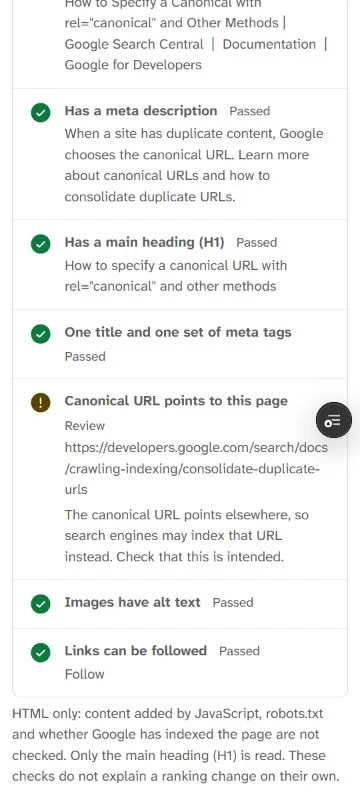
The canonical row prints https://developers.google.com/search/docs/crawling-indexing/consolidate-duplicate-urls without ?hl=en. Compare that base address with the requested parameter URL and read the answer at both.
Copy the printed destination into your notes before changing a setting. Review asks whether the different destination is intended; it does not establish an error. Here, the next job is to open the base guide and compare its answer with the parameter version.
The other passed checks describe this fetched page. They are useful context, but your canonical decision comes from the actual destination and the answer it serves. A headline total would leave that decision unfinished.
Record the First Response and the Final Address
For each URL, record the response before following a redirect and the page reached afterward. In your browser's developer tools, open the network panel, retain the request log, and load the full address. Inspect the initial document request's status and any Location response header, then record the final document address and status. If you need help with that panel, give these exact fields to your host or developer.
The legacy address returned 301, directing the request to the base guide; that destination returned 200. A 301 is a permanent redirect response, while a 200 is a successful response serving the page. Looking only at the final 200 would hide the visitor movement that distinguishes this row.
The English parameter version returned 200 and stayed at its parameterized address. Its HTML named the base guide as canonical, but the request remained on the alternate address. Google's canonicalization guidance, checked October 6, 2026, describes canonical declarations and redirects as ways to signal a preferred version; the observed address behavior tells us which one is happening here.
Requested address | First response | Final address and response | Declared canonical in final HTML | Main answer |
|---|---|---|---|---|
Base guide | 200 | Base guide, 200 | Base guide | Canonicalization |
English parameter version | 200 | English parameter version, 200 | Base guide | Same canonicalization answer |
Legacy address | 301 | Base guide, 200 | Base guide | Same canonicalization answer |
Redirects guide | 200 | Redirects guide, 200 | Redirects guide | Different answer: redirect implementation |
For the redirecting row, the declaration belongs to the final guide's HTML. Keep it separate from the legacy address's first response. This gives you a precise request path rather than an assumption based on a page that eventually loaded.
Verify What the Destination Actually Answers
Open the base guide and the English parameter version together. Compare the main heading, the opening explanation, and the sections that do the work. Both explain choosing a canonical version and compare methods, including link declarations, sitemaps, and redirects. The retained text comparison found the same extracted answer at both addresses and at the legacy address's final destination.
That comparison supports the base guide as an equivalent destination for this observed group. A matching title alone would be weaker: two pages can have similar titles while differing in instructions, examples, or downloadable material. On your site, check any section a visitor following the old link would reasonably expect to find.
Now open the redirects guide. It explains redirect types and implementation, including permanent and temporary server responses. Someone needing instructions for configuring a redirect has a different next step from someone choosing how to declare a preferred duplicate URL. Preserve that distinction even though both pages discuss URL handling.
Google's redirect documentation, checked October 6, 2026, provides the redirect-specific guidance. Keeping its observed self declaration makes sense in this map because it delivers its own answer. Sending it to the canonicalization guide would lose the focused route we just verified.
Choose the Behavior You Want to Preserve
Use the filled map to ask what should happen when someone requests each address. For the English parameter version, the observed combination is an accessible page plus a declaration pointing to the equivalent base answer. On your site, keep that combination only when you intend visitors to retain access to the alternate address.
The legacy address demonstrates a different outcome: the visitor reaches the base guide through a permanent redirect. When an old address should consistently deliver its replacement, verify that replacement's answer before requesting the redirect. Use the direct base URL when adding a new link to this Google guide.
The redirects guide stays separate because it answers a different practical question. There is no need to make it point to the canonicalization guide simply to reduce the number of URLs. Record the distinct answer as the reason for preserving it.
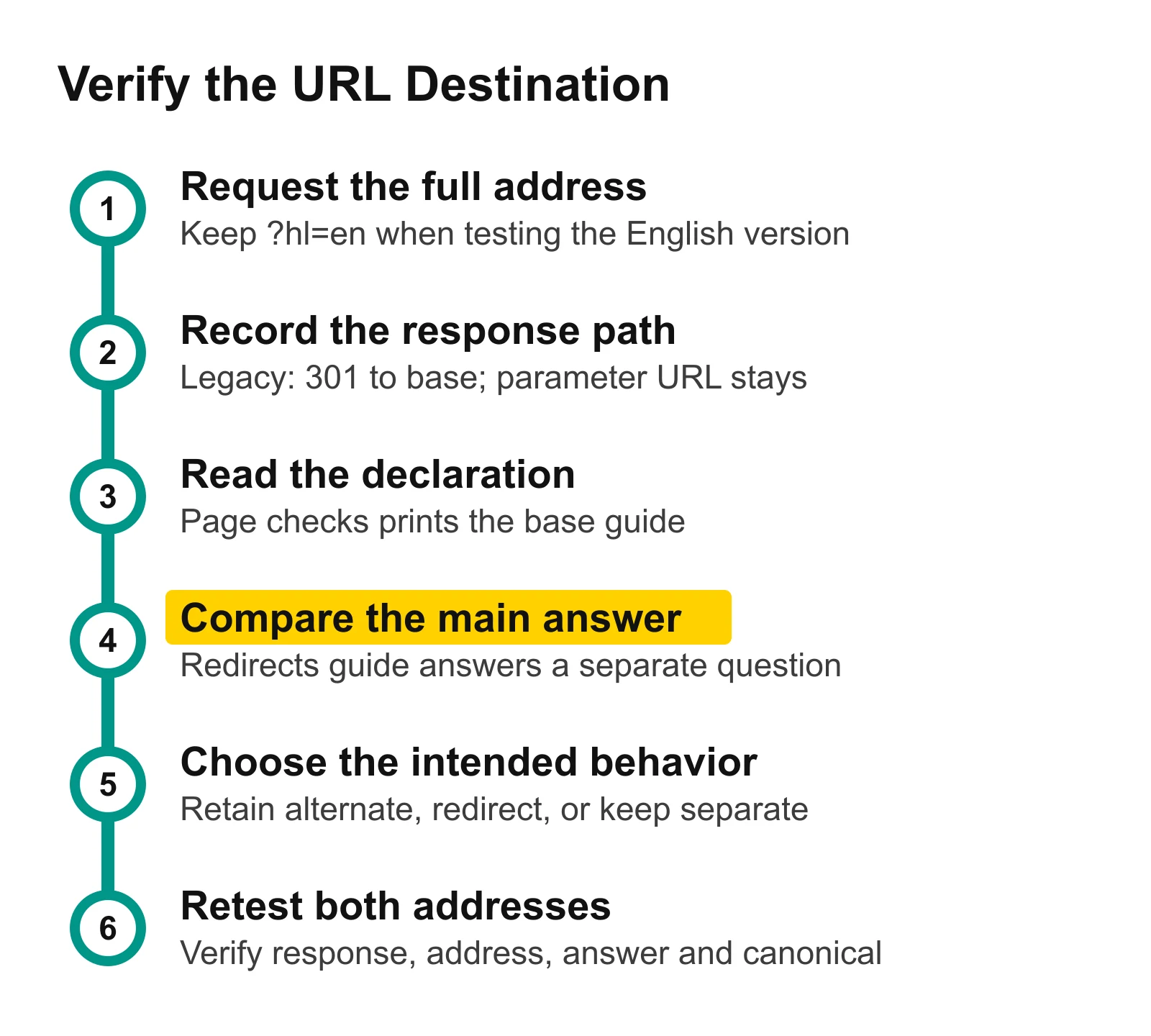
Follow the request through to its answer before choosing a treatment. The English parameter version and legacy address reach the same answer through different behaviors; the redirects guide keeps its separate purpose.
Make the Request Specific Enough to Test
Download the completed URL verification map. It contains all four full requested URLs, observation dates, first and final statuses, final addresses, declarations, answer relationships, and next checks. Keep the observed values when you copy it, then add a separate row for your own proposed behavior.
For a retained alternate like the English parameter version, your request should name the alternate address and the full preferred destination. Specify that the alternate should still serve its equivalent answer, and that its emitted HTML should declare the chosen base address. Then confirm that the base address itself returns the expected answer and declaration.
For an address being retired like the legacy path, name the exact source and destination, request the permanent response you intend, and state which content the destination must preserve. Test the source's response and destination separately. “Redirect the old page” leaves the target and the expected landing answer unresolved.
For a separate answer like the redirects guide, record that it stays accessible at its own address with its own declaration. If a proposed site-wide setting would send all three kinds of address to one place, these rows show exactly which separate answer needs to be retained. Choose the appropriate control in your platform's documentation using those requirements.
Retest the Whole Map After a Change
Revisit the source address, capture its initial response, and open the destination directly. Check the final address, read the preserved answer, and inspect the declaration in the returned page. For the parameter-version pattern, explicitly confirm that the parameter remains in the final address; for the legacy pattern, confirm that it moves to the intended base.
Page checks reads returned HTML; record response movement and answer equivalence manually, and use Search Console URL Inspection on a property you control when you need Google's selected canonical. Keep that selected-canonical field unknown until you have the relevant observation. Your response map can be complete while that separate field remains unanswered.
Next, open Page checks and enter one alternate URL from your own site, preserving its full path and parameters. Write down the printed canonical destination, open it, and decide whether it serves the same answer and whether visitors should remain on the alternate address.
For broader page selection, use the website SEO performance guide. If the destination's index state needs investigation, follow the page-not-indexed checks; if its heading and summary need clearer wording, use the title and meta-description guide.