- Content Planning
- Tutorial
How to Write Product Descriptions With Supported Facts
Editorial responsibility: SearchCub
Write a product description by choosing practical questions, checking the facts that answer them, and turning those answers into a clear paragraph. You will finish a description for the real Helinox Chair One and have a filled record you can adapt to your own product. SearchCub's Keyword overview helps you choose wording; you write the paragraph using the manufacturer's specifications and instructions.
Our example uses helinox chair one, looked up for United States · English · Desktop on October 7, 2026. Keep that exact model throughout: the description needs to identify the item, explain its packed size and weight, distinguish its load limit, and give its care instructions. The finished paragraph appears below, with the decisions that make each sentence supportable.
Read the Actual Search Wording
Start with the exact product name, then look for wording that suggests an answer your description can give. Open Keyword overview, choose Keyword, enter helinox chair one, set Region to United States, and click Search keywords. In the returned Keyword set, read the Keyword, Monthly searches, and Difficulty columns.
Monthly searches estimates how often a phrase is searched in a month in the selected market. Difficulty is an estimated score on a scale from 0 to 100 for ranking competition. In the October 7 SearchCub result, helinox chair one weight has 30 estimated monthly searches in the United States and difficulty 4; helinox chair one weight limit has 10 estimated monthly searches, with difficulty Not supplied.
These estimates describe searches in that market, not visits to your shop or the priorities of your own customers. For this writing task, the useful discovery is the distinction between weight and weight limit. Give each a separate answer, even though both involve weight.
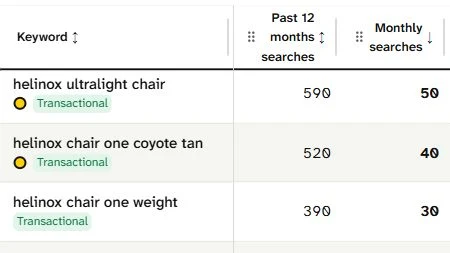
The weight row gives you a phrase to answer and shows 30 estimated monthly searches in the United States. For the Chair One, give carried packed weight its own answer.
The crop shows the wording and monthly estimate; the difficulty values above come from the same result's recorded metrics. You can make the writing decision from these two returned phrases without collecting a longer list.
Choose Questions Your Paragraph Can Answer
Turn useful wording into a question, then check whether you have a source for its answer. Here, we translate helinox chair one weight into “What weight will I carry?” and helinox chair one weight limit into “What load does the maker list?” These are our writing questions, rather than questions returned by SearchCub's Questions view.
Add the practical questions the manufacturer can answer for this exact item. The Helinox Chair One product page, checked on October 7, 2026, provides the identity, construction, packed specifications, capacity, and care instructions used here.
Question to answer | Source to use | Decision for this paragraph |
|---|---|---|
Which item is it? | Product name and category | Identify Helinox Chair One as a collapsible outdoor chair. |
What does it pack down to? | Packed dimensions | Give the case dimensions with the packed label. |
What weight will I carry? | Packed weight | State packed weight in its own sentence. |
What load does the maker list? | Capacity specification | Attribute the assembled load limit to Helinox. |
How do I clean the seat? | Manufacturer care instructions | Include the cleaning method and machine-washing restriction. |
Download the filled product-description claim and answer record. It contains the questions, source sections, decisions, finished answers, and reasons for leaving some claims out, so you can follow the example while you write.
Match Each Sentence to Its Source
Use a physical specification as a physical specification, a rating as an attributed rating, and an instruction as an instruction. This prevents a factual detail from expanding into a promise the source does not support.
For construction, the manufacturer's Chair One page describes an aluminum frame, connected poles, and mesh panels. “The chair has an aluminum frame, connected poles and mesh seat panels” keeps the sentence about components. Adding a claim about all-day comfort would require different evidence, so leave that promise out of this description.
For size, the same page lists packed dimensions of 14 × 4.5 × 4.5 inches. Keep packed beside the dimensions: “It packs into a zippered case measuring 14 × 4.5 × 4.5 inches.” That gives you dimensions to compare with your own available space, without assuming a particular bag will fit it.
For care, follow the manufacturer's instruction rather than presenting personal experience. Helinox directs warm-water spot cleaning, full drying before packing, and no machine washing. Include the restriction with the method, so “spot-clean with warm water” does not turn into an incomplete instruction. Each of these facts is recorded separately in the download, even when several fit into one sentence.
Separate Packed Weight From Load Capacity
Packed weight answers what you carry; load capacity answers the maker's stated limit for the assembled chair. Helinox lists a packed weight of 2 lb 2 oz (965 g) and a capacity of up to 320 lb (145 kg) when assembled. Keep the manufacturer's paired units and the scope of each figure. Helinox specifications
The first version combined both answers:
Helinox lists a packed weight of 2 lb 2 oz (965 g) and a load capacity of up to 320 lb (145 kg) when assembled.
The returned wording gives us a reason to make the distinction easier to read:
Helinox lists a packed weight of 2 lb 2 oz (965 g). For load, Helinox lists a weight limit of up to 320 lb (145 kg) when assembled.
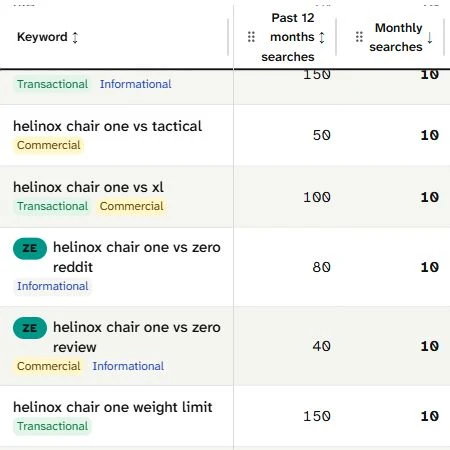
Weight limit is a separate returned wording with 10 estimated monthly searches in the United States. Answer it with Helinox's assembled load rating instead of treating it as another carried-weight figure.
Both product facts were already available before the lookup. Search wording changed their emphasis and sentence structure; the manufacturer remains the source of the figures. Keeping “Helinox lists,” “up to,” and “when assembled” also preserves the rating's attribution and conditions.
Leave Unresolved Details Out
When source sections disagree, omit the disputed detail until it is clear. In the retained Chair One page, seat-height wording differs between the specification card and comparison FAQ, and chair-only assembled weight differs between the table and FAQ. The download preserves both issues so they remain visible in your notes. Helinox source page
For this paragraph, choose packed dimensions and packed weight, whose source labels are usable. Leave seat height and assembled ounces out. Guessing which value is correct, silently changing a label, or borrowing a specification from another Chair One variant would add an unresolved claim to the copy.
If seat height is essential for the product you are describing, make that your next source question: ask the manufacturer which value describes the seat and which model it applies to. For this exercise, the remaining facts are enough to finish a useful description. Record the omission before drafting, so it survives later edits that shorten or rearrange the paragraph.
Write the Finished Product Description
Put the supported answers in an order the reader can follow: identity and construction, packed size, carried weight, assembled load limit, then care. Here is the completed writing exercise based on the checked Chair One page; it is not Helinox's official copy or a product review.
Helinox Chair One is a collapsible outdoor chair with an aluminum frame, connected poles and mesh seat panels. It packs into a zippered case measuring 14 × 4.5 × 4.5 inches. Helinox lists a packed weight of 2 lb 2 oz (965 g). For load, Helinox lists a weight limit of up to 320 lb (145 kg) when assembled. For seat care, the manufacturer directs you to spot-clean with warm water and dry fully before packing; machine washing is excluded.
Product facts and care instructions: Helinox Chair One, checked October 7, 2026. The separate weight answers use wording found in the dated SearchCub result.
The paragraph is short because each sentence has a job. The opening names the item and describes its components. The next three sentences answer distinct physical questions. The final sentence keeps the cleaning method and restriction together.
Read your own version aloud after arranging the answers. If two sentences answer different questions, keep the distinction clear when combining them. If an adjective adds a claim such as superior comfort, return to the source record before retaining it. The goal is complete, supported copy at a useful reading length.
Check Every Retained Claim
Use the filled CSV to check individual claims, not just the paragraph as a whole. Its rows connect identity, packed size, packed weight, load capacity, construction, and care to their respective manufacturer sections. The final row records the weight-wording edit and points back to the packed-weight and load-rating facts.
For each sentence, find the corresponding row and compare the final wording with its source scope. The packed-size sentence should retain the dimensions and packed label. The load sentence should retain Helinox's attribution, “up to,” and “when assembled.” The care sentence should include the machine-washing restriction as well as the cleaning method.
Then check the rows marked Hold or Omit. Seat height, assembled ounces, and unsupported performance or comparison claims should stay out of the finished paragraph. A filled omission row is useful: it explains why a tempting detail is absent and prevents a later rewrite from quietly adding it back.
To adapt the record, replace the product questions, URLs, source sections, and answers with those for your own exact item. Keep each answer beside its evidence and decision. When one sentence contains several facts, verify each fact separately before accepting the sentence.
Finish One Answer for Your Own Product
Open Keyword overview and type your exact product name first. Choose your Region, click Search keywords, and select one useful returned phrase that your source can answer. Write that answer, record its source and scope, then build the rest of the paragraph around the supported questions for the same item.
For broader topic planning, use keyword research for bloggers. If you first need to decide which page should carry the description, follow keyword research for ecommerce. Once the visible description is finished, SEO titles and meta descriptions covers the separate search-preview copy.