- Competitor Research
- Tutorial
Competitor Content Analysis: Follow the Next Answer
Editorial responsibility: SearchCub
Analyze competitor content by the question each page answers, then follow its links before deciding an answer is missing. You will finish with a filled list of four different answers and a checked route from an overview to a practical guide. Use SearchCub Top pages to find the starting URLs, then read the public articles.
Our worked example is Productive Blogging. The useful decision comes early: its affiliate setup answer is already present downstream of its money overview, so mark that branch covered. The SEO guide serves a separate job and belongs on a separate route through your notes.
Competitor content analysis is a structured reading exercise: identify the questions a competing site answers, describe how it answers them, and record what you learned. A page about what blogging means, a list of income methods, and a setup procedure can all mention blogging while doing different work for the reader. Keeping those jobs separate makes your findings more useful than a list of titles.
1. Choose Starting Pages With Different Jobs
Open Top pages, choose Domain, enter productiveblogging.com, set Region to United States, and click Search. In the domain result, select Pages. If you already have a saved result, reopen it and go to the same tab.
In this example, the saved United States result reopened on October 6, 2026 shows 25 linked pages loaded from 320 matches. These saved results have no latest observation month supplied, and their search estimates are not the site's analytics. The loaded list is a starting sample rather than a complete site list; SearchCub supplies page leads, while you identify answer roles and links by reading the public articles.
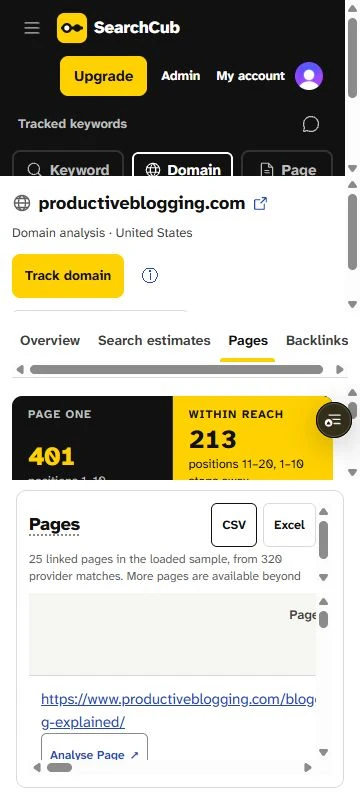
Read the sentence below Pages to see the loaded sample's size, then open the blogging-explained URL in the first visible row. The public article is where you check the question it answers and where its links lead.
Choose pages because they answer different questions. Here, the starting set is the blogging explainer, the money overview, and the beginner SEO guide. Reading another income overview would give a closer comparison of that one job; these three starting pages instead let you see how different answers connect.
Write one short question beside each URL before taking detailed notes. For the explainer, use “What is blogging, and where should I start?” For the money overview, use “What are the ways a blog earns money?” For the SEO guide, use “What does working on blog SEO involve?” Those questions keep each reading session focused.
2. Read the Answer and Its Place on the Site
Start with Blogging Explained. Its question-led sections define blog, blogger, blogging, and blog post, then introduce starting and operating questions. That makes “orientation” a useful description of its role: it helps someone understand the subject and find a direction.
Read beyond the headings to the surrounding links. The article points to the money overview, the beginner SEO guide, and the affiliate guide. Record the destination and the question that makes the link useful, rather than simply writing “has internal links.”
Next, read How Do Blogs Make Money?. It groups its answer into advertising, affiliate links, sponsored posts, products, and services. Its role is a mechanism overview: help the reader understand the available approaches and reach more specific reading.
Notice the difference between a role and a format. “Mechanism overview” describes what the answer does; “list of five methods with explanations and links” describes how it is presented. Recording both helps you recognize that another site could answer the same question with a comparison table, or use the same list format for a different question.
The beginner SEO guide takes another route. Its sections cover keyword research, optimization, readability, site structure, backlinks, and technical work, with links to deeper lessons. Classify it as an operational overview, then keep it beside the income branch in your notes rather than treating it as the next income step.
3. Follow the Link That Could Change Your Finding
The money overview explains affiliate links and points to A Beginner's Guide to Affiliate Marketing for Bloggers. Open that actual link. The practical answer you are looking for is downstream of the overview.
The destination contains an ordered procedure: identify a product, find and apply to an affiliate program, add links to existing posts, research relevant searches, write supporting posts, and promote them. It also has sections about disclosure and managing links. Record those as observed subjects in the article, without copying their advice into your own instructions.
This changes the finding from “the overview stops before setup” to “the overview connects to a setup guide.” The first sentence describes one article's boundary; the second describes a checked connection between two different answers. A short overview can do its job by explaining a choice and linking to a procedure.
There is also a direct link from the blogging explainer to the affiliate guide. Your notes should preserve both entries: someone could reach the procedure through the money overview or from the introductory explainer. The SEO link leaves the explainer for a different question, so keep it as a parallel branch.
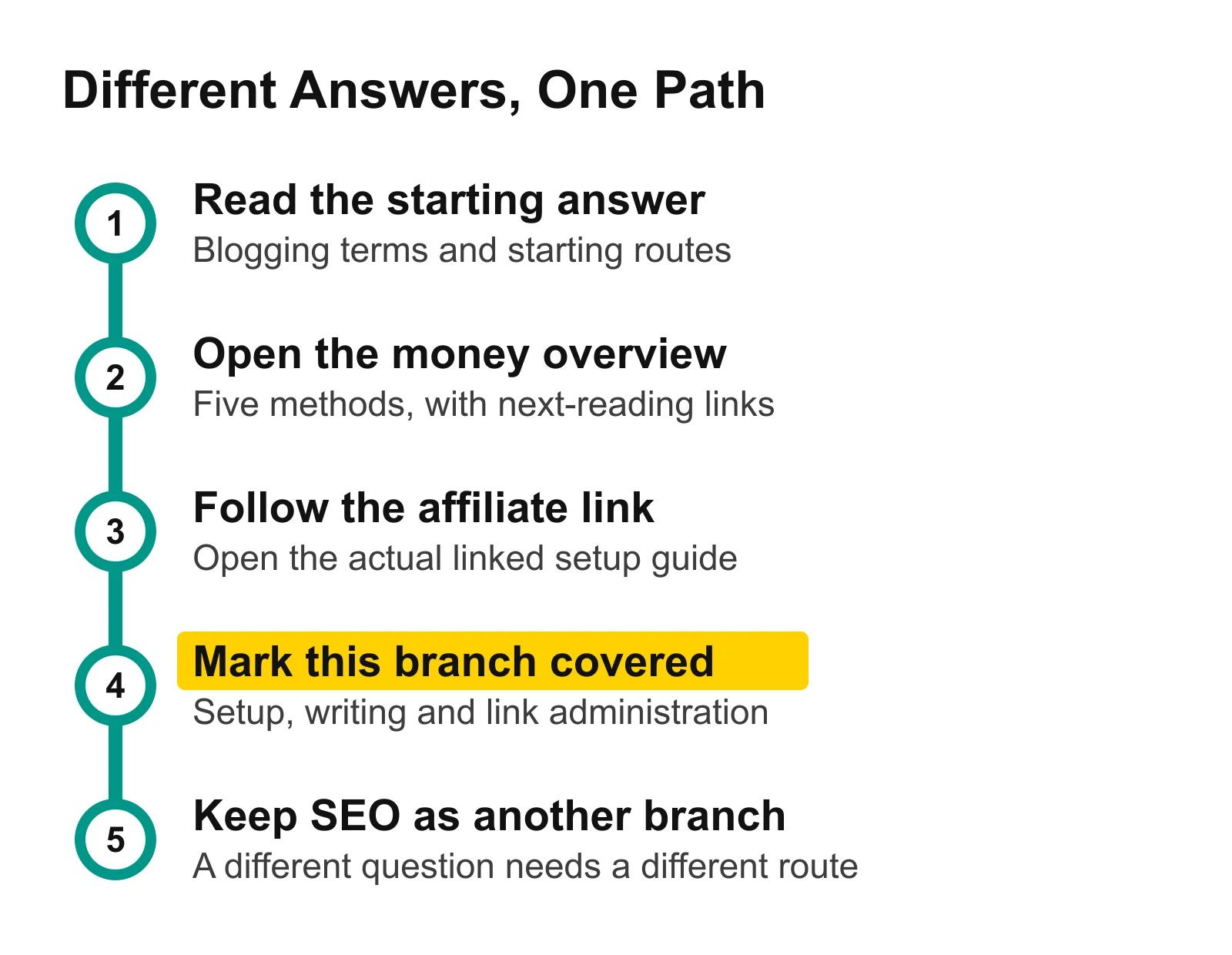
The money overview's affiliate link leads to a procedure, which changes the answer-presence decision to covered. Keep the SEO route separate because learning SEO and starting affiliate work are different jobs.
4. Fill a Page List You Can Use
Use one row per answer, with a specific question, a role, a format, and an observed next link. The table below is filled from the four public articles read for this example on October 6, 2026.
Public page | Reader's question | Role and format | Observed next answer | What to record |
|---|---|---|---|---|
What is blogging, and where do I start? | Orientation; question-led explainer | Money overview, beginner SEO guide, and affiliate guide | Entry point with income and SEO routes | |
What are the ways a blog earns money? | Mechanism overview; five-method list | Affiliate setup guide | Overview connects to a practical answer | |
What does blog SEO involve? | Operational overview; subject sections | Keyword research explanation and practical research lesson | Separate SEO branch; next check is the relevant lesson | |
What is the sequence for beginning affiliate work? | Procedure; ordered stages and supporting sections | Research, writing, and link-management articles | Affiliate setup answer present; supporting links are next checks |
Download the filled four-page answer list. It includes the full public URLs, the answer boundaries, the evidence you would need before using the advice, and the next thing to check. Keep the completed rows when you add your own reading so you can see how a finding should look.
Give each observation a precise home. Put “links to the affiliate guide” in the next-answer field. Put “overview to procedure” in the role interpretation. Put “covered in this inspected branch” in the decision field. This separates what you saw from what you concluded and makes later corrections simple.
5. Match Your Source to Your Next Decision
Reading the public body is the right source for checking whether an explanation, procedure, or link is present. Use the relevant section and destination URL to support that finding. A title alone gives you a lead; reading the answer supplies the detail needed to classify it.
Using the advice is a different next task. For affiliate setup, check the chosen program's current terms and applicable official requirements before acting. For an SEO lesson, check current official search guidance and the tool steps it recommends. Add those source requirements to the row so a page-presence finding does not silently become a recommendation.
“Covered” here means that an answer exists in this inspected branch; it does not establish complete site coverage, reader behavior, performance, income, or the current correctness of every instruction. The concrete result is narrower and useful: the apparent missing affiliate procedure has a real destination, and you have recorded how to reach it.
When you repeat this exercise, finish a branch before expanding your list. If an overview links to the precise follow-on question you wrote down, open that answer and update the row. If you have reached the answer, record covered; if your next question is different, give it a separate row and name the public source you need to inspect.
For keyword-led page selection, continue with competitor keyword research. If your task becomes comparing two answers to one search, use compare competing pages by search intent. To retain a ranking finding and its follow-up decision, use the lightweight competitor research log.
Open Top pages, enter the competing domain you want to read, and choose your region. Start with pages that answer different questions, then follow one real next-answer link and write down whether that branch is covered.