- Content Planning
- Tutorial
Content Localization: Keep, Adapt or Hold Each Answer
Editorial responsibility: SearchCub
Content localization adapts an existing answer to a market's language, wording, units and context while preserving the facts that make it useful. You will finish a worksheet that marks each part of two country versions keep, adapt or hold. Use Page analysis to find relevant searches associated with each version, then check the proposed answer against its local source.
Start with the reader's task. What are they trying to identify, understand or do, and which existing page should help them? Keep the useful answer, adapt the parts that change for the market, and hold anything your sources leave unresolved. Translation can be part of that work; two pages written in English can also need different terms, supplied measurements or destinations.
This walkthrough uses IKEA's existing US and UK pages for the same KALLAX item. It is a public example of reconciling English country versions, with proposed wording decisions you can inspect. Wider language and cultural review will depend on the content you are adapting.
1. Fix the item and the answer you are localizing
Match the actual item before comparing words. The US KALLAX shelf unit and UK KALLAX shelving unit both identify article 903.015.55 in the pages observed on October 7, 2026. These are the existing destinations for this example.
The shared task is to identify the two-cube unit and understand its layout and use. Keep that task fixed as you examine the country versions. A different product, another configuration or a new page purpose would need its own facts.
Make two columns in your notes: US and UK. Add the exact page URL, item identifier, local product name and source date to each. This small step helps you catch a familiar brand name attached to the wrong item, and gives every later wording choice a clear destination.
2. Read each page's searches in its own region
Open Page analysis, choose Page, and paste the full US URL:
https://www.ikea.com/us/en/p/kallax-shelf-unit-white-90301555/
Set Region to United States, click Research page, and read the Overview keyword table. The English report retrieved on October 7, 2026 loaded 13 matching rows. Monthly searches estimates how often a phrase is searched in the selected country in a month.
Read the words before deciding what to change. The US rows include ikea 2 cube shelf at 30 estimated monthly searches and ikea kallax wall mount at 170. Further down the same report, kallax wall mount has 390. Those phrases point to product identification and wall-use answers worth examining, without requiring a comparison of their positions.
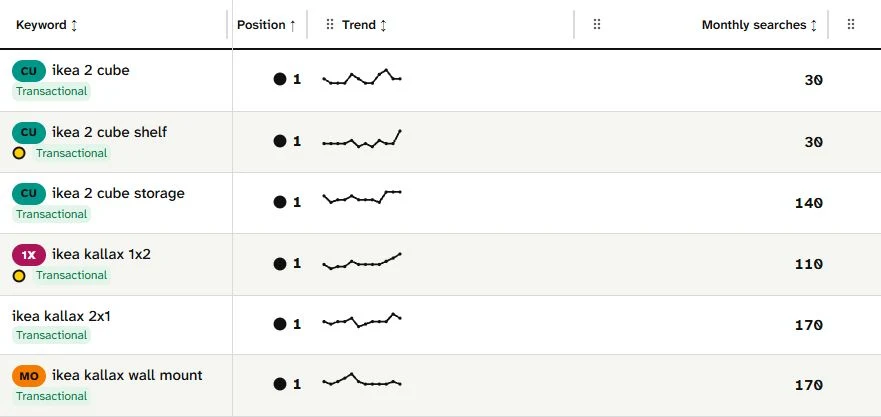
The US/en Page analysis for article 903.015.55 shows ikea 2 cube shelf at 30 and ikea kallax wall mount at 170 estimated monthly searches. This table-only crop highlights wording that makes the wall-use answer worth finding in the local product source.
Next paste the exact UK URL into Page:
https://www.ikea.com/gb/en/p/kallax-shelving-unit-white-90301555/
Set Region to United Kingdom, click Research page, and read its Overview separately. This English report loaded 15 matching rows. It includes double kallax unit at 70 estimated monthly searches and ikea kallax 2x1 at 320, alongside other two-cube and layout phrases.
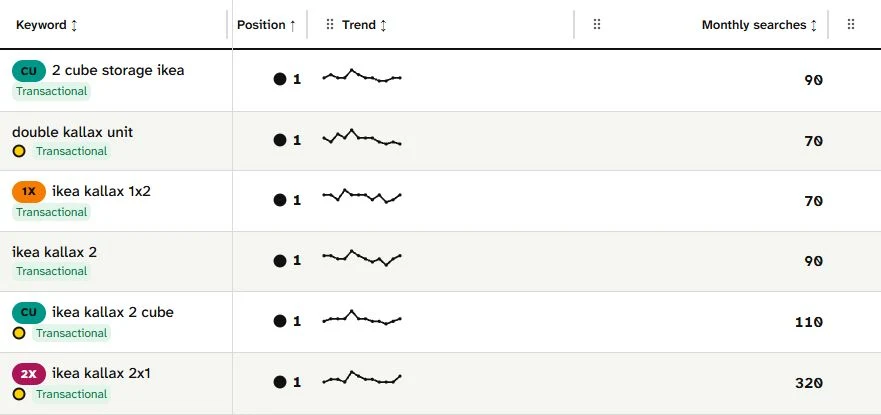
The UK/en Page analysis for article 903.015.55 shows double kallax unit at 70 and ikea kallax 2x1 at 320 estimated monthly searches. The table-only crop gives you wording to clarify the exact item and layout alongside IKEA's local product name.
These are third-party search estimates, not the site's analytics, and each loaded table is a sample; a phrase absent from one report remains unknown in that market. Retrieval tells you when the report was obtained, while its stored ranking observations date from August and September 2026. Both requests used English; short branded phrases also carried language-mismatch flags, so those flags are not a reason to change the requested country or language.
3. Keep the shared answer and adapt its emphasis
Keep the two-cube concept in both versions. Five exact phrases occur in both reports, including ikea kallax 1x2, ikea kallax 2x1 and kallax two cube. IKEA's two local bodies also describe standing or lying use. There is a common answer to preserve rather than a need to invent a different product story for each country.
For the US version, make the wall-or-floor answer easy to find. The two wall-mount phrases give that choice a concrete search connection. The US product details say the unit can hang on a wall or stand on the floor, and that a wall-hung frame's maximum load depends on the wall material. Keep that constraint beside the answer, together with the maker's secure-anchoring guidance.
For the UK version, clarify which item and layout the words refer to. Record double kallax unit as an observed search phrase alongside the local name, KALLAX Shelving unit, and the article identifier. A useful answer identifies the actual two-cube item; it need not rename the product “Double KALLAX” or squeeze every spelling of 2x1 into the paragraph.
The change is answer prominence and clarity. The US wording supports drawing attention to wall use; the UK wording supports clarifying the item behind an informal name. Keep wall-use information available in both versions, and treat these as observed searches associated with these pages rather than rules about how every American or British reader speaks.
4. Use the local source for the factual answer
Search wording tells you which answer to examine. Copy its factual details from the relevant maker page with their original labels and scope. For this item, the local observations give you the following decisions:
Part of the answer | US observation | UK observation | Your decision |
|---|---|---|---|
Product identifier |
|
| Keep the same item identity |
Local name | Shelf unit | Shelving unit | Use the local source name |
Material and descriptive spelling | fiberboard, personalize, favorite | fibreboard, personalise, favourite | Adapt wording while keeping the meaning |
Care term | mild dish detergent | mild washing-up detergent | Use the local term and keep the cleaning instructions |
Assembled width and depth | 30 1/8 inches; 15 3/8 inches | 76.5 cm; 39 cm | Keep each field's supplied figure, unit and label |
Load on top | 55 lb | 25 kg | Keep the top-load scope |
Load per shelf | 29 lb | 13 kg | Keep the shelf-load scope separate |
The measurements come from the US maker page and UK maker page observed on October 7, 2026. Keep assembled dimensions separate from package dimensions and the optional underframe, which is sold separately. Use the supplied local figures rather than adding conversion precision of your own.
Match the destination as carefully as the sentence. A UK product reference goes to the UK item page; a US reference goes to the US item page. When you add an assembly or care link, follow that destination and check the item and country before using it in your finished copy. This keeps a familiar-looking link from taking the reader to instructions for another item or locale.
5. Hold the claims that your sources leave open
A hold is a useful result when it names the exact problem. The UK page has an unresolved discrepancy: its HTML title says 77x42 cm, its visible product heading says 77x41 cm, and its assembled height field says 41 cm. The UK search report repeats the 77x42 title. Keep both observations in the worksheet and leave the disputed dimension out of your proposed headline until the maker clarifies it.
Handle the wall-use answer with the same care. Both country pages require secure anchoring with suitable screws and plugs; both say the wall-hung load depends on wall material. Hold a fixed wall-hung weight rating or a detailed fixing procedure that the checked source does not supply. The top and shelf figures above retain their own scopes.
Also leave local stock and delivery promises open: the fetched availability sections were still checking. Exclude searches that take you away from this item, such as the US ikea expedit dimensions 2x4 row and the UK unit one store row. A ranking attached to the exact URL is a starting point for reading, not a reason to answer an unrelated product or store question.
6. Finish one worksheet for the two versions
Download the filled KALLAX localization worksheet. It contains the observed phrases, local source facts, decisions, dates and destinations used here. Keep your own pair of pages in the same structure so a proposed edit stays attached to the evidence that supports it.
For every row, make the action specific. “Adapt for the UK” leaves you guessing; “clarify the two-cube item behind the observed double-unit phrase” tells you what the paragraph needs to do. “Check dimensions” becomes more useful when it records the conflicting title, heading and height, then holds just the affected headline claim.
You should finish with a common answer to preserve, a few local changes to make and named questions to resolve. That is a practical content-localization plan you can use without changing the product, multiplying pages or treating a higher search estimate as a better sentence.
Use the same method on your existing page
Open Page analysis, paste one existing country-page URL and choose its matching Region. Start with the relevant phrases that make an answer easier to identify or use. Then compare the corresponding country version and record the shared answer, local change and unresolved claim in your worksheet.
For broader topic planning, use keyword research for bloggers. If you first need to choose product, collection or help destinations, follow keyword research for ecommerce. For writing one supported product paragraph, use how to write product descriptions.