- Keyword Research
- Tutorial
Does Your Domain Name Affect SEO? How to Choose One
Editorial responsibility: SearchCub
A domain name is one small signal, not a shortcut. Google counts the words in a domain name as one of many signs of relevance, but its exact match domain system keeps it from giving too much credit to an address built to match a search. The one domain choice Google calls a strong signal is a country ending such as .uk, which points the site at that one country. So choose a name you can grow into, then check it in SearchCub's Keyword overview before you buy it. You will see whether another site already answers to the name, and what kinds of addresses hold page one for your topic.
What Google says about domain names
Google's guide to its ranking systems puts the first part plainly: "Our ranking systems consider the words in domain names as one of many factors to determine if content is relevant to a search." The same section describes an exact match domain system that adjusts for domains designed to match a particular search. Its example is an address built from the words "best-places-to-eat-lunch", made in the hope that those words alone would lift a page (Google: ranking systems guide).
The ending is a separate question. In a 2015 post about new endings such as .guru, Google said it treats them like .com and .org, and that keywords in an ending give no advantage or disadvantage in search (Google: handling of new top level domains). That post is now marked as older guidance, and it covers endings only, not the rest of the name. It also advised choosing a domain that fits your long-term needs, because changing domains later takes time to be processed for Search.
Country endings are the exception. Google's current guide for international sites says a country-code domain such as .de gives "a strong signal to both users and search engines" that the site is meant for that country, and lists the cost: it can only target a single country (Google: managing multi-regional sites). Some country codes that people use as words, such as .tv and .me, Google treats as generic endings instead.
That leaves three practical questions. Does the name fit what you will write about in five years? Does another site already answer to it? Will readers remember and type it? SearchCub helps with the second.
What people searching "does domain name affect seo" find
The search itself is small but clear. does domain name affect seo has about 30 searches a month in the United States, difficulty 8 and an Informational tag in SearchCub, an estimate last updated on 16 September 2026. People asking it want an explanation before they buy a domain, not a product page.
Its SERP overview, checked for United States desktop results on 7 October 2026, listed nine organic results under an AI overview. They were explainers with titles such as "Domain Names and SEO: Exploring the Connection" and "SEO-Friendly Domains in 2026: Truth vs. Myths". There was also a Reddit thread about changing a domain name, a LinkedIn post on domain extensions and a Quora question about endings and subdomains. None of the nine addresses contained the words domain, name or seo.
What page one looks like across four searches
One search proves little, so look at four. On 7 October 2026 SearchCub retrieved the results pages for what is seo, how to write a blog, seo vs ppc and does domain name affect seo, nine organic results each, for the United States.
Across these 36 result rows, no hostname spelled out its full query. Looking only for each query's topic words, and counting write, writer and writing as one family, two hostnames matched: goinswriter.com and socialmarketingwriting.com, both in the how to write a blog sample. Short grammatical words such as a and to were excluded.
Four dated snapshots are evidence, not a rule, and they show what ranks, not why. They fit Google's description of domain words as one factor among many: in all four, page one was held by pages whose addresses did not spell out the search.
Choose the kind of name
Most bloggers pick one of four kinds of name. Use this table to choose:
Kind of name | What it locks in | Fits when |
|---|---|---|
Keyword name, such as a blog called after its topic | Your scope: a name about one topic is awkward when you widen it | You are sure of the topic for years |
Made-up brand name | Nothing about the topic; you build its meaning | You may widen the topic, or want a name you can own outright |
Your own name | You, wherever you go next | The blog is your portfolio or your voice |
Country ending such as .uk | One country in Google's eyes | You serve readers in that country only |
Whichever kind you pick, check that no other site already answers to the name. That is the step SearchCub can do for you.
Check a name in Keyword overview
The worked example is a name a new blogger might like for a blog about blogging: Productive Blogging. It was looked up in SearchCub for the United States on 7 October 2026.
Open Keyword overview, choose Keyword, type the name you are considering (here
productive blogging), choose your readers' Region and click Search.Read the panel:
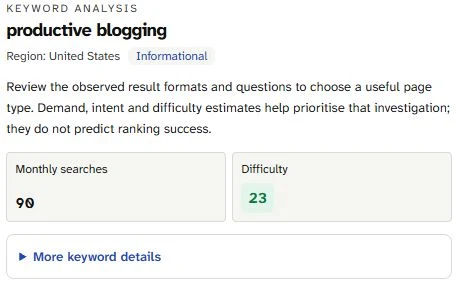
Keyword overview for productive blogging, United States, 7 October 2026: an Informational tag, about 90 searches a month and difficulty 23, all estimates. The tag alone does not tell you whether the name is taken.
Scroll to the SERP overview and look at who answers the name. For
productive blogging, productiveblogging.com holds the first and third organic results, and a YouTube channel called Productive Blogging is second. A site already answers to this name, so a new blog should pick another. Other results use the words as an ordinary phrase, such as CNET's "Online tools for more productive blogging" and ProBlogger's "5 Steps to Creating a Productive Blogging To Do List". A name made of common words is shared with everyone who uses those words.Compare with names that are plainly taken. In the keyword set for
does domain name affect seo,godaddyshows 823K searches a month andnamecheap201K, both tagged Navigational. A Navigational tag means people use that search to reach one particular site.
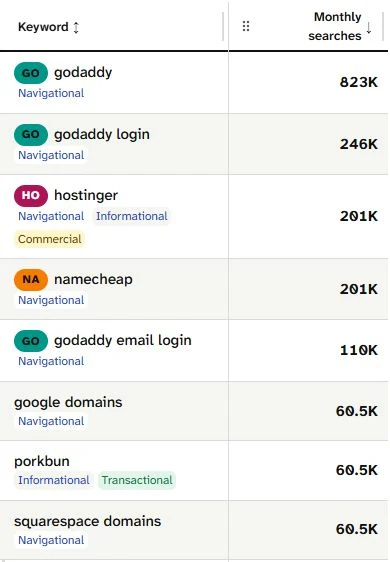
Company names come back as Navigational rows with large volumes. A name that returns rows like these, or a results page led by one site, is taken in search, even if a variation of the domain is still free to register.
Open the SERP overview for your topic's main search and note who holds page one, the way the four searches above were read. If page one is held by pages whose addresses do not spell out the search, as in all four examples, a keyword domain is no shortcut there.
A brand-new made-up name will usually show little or no search demand and no one site answering to it. That is what you want: nobody is looking for anyone else under that name.
What this check cannot tell you
SearchCub does not tell you whether a domain is free to register or whether a name is trademarked; check both with a registrar and the trademark office for your country. The volumes are estimates for one region, and a snapshot of today's page one does not predict where your own site will rank.
Your next step
Shortlist two or three names, then run each through Keyword overview before you buy one. Drop any name whose results page already belongs to another site, whatever its tag says. If you are still deciding what the blog is about, start with how to choose a blog niche. What is SEO explains the basics your new site will be judged on, and branded vs non-branded keywords shows how your name's own searches grow once readers know it.