- Keyword Research
- Tutorial
How to Choose a Blog Niche
Editorial responsibility: SearchCub
Choose a blog niche by finding a subject with several reader problems you can keep answering well, then setting its boundaries before you commit. You will finish with a subject promise, the material it requires and a decision to test it, narrow it or set it aside. Use SearchCub's Keyword ideas to inspect real searches while you make that decision.
Our candidate is home cold-brew preparation. The example uses the real cold brew coffee set for the United States, retrieved on October 4, 2026, and reopened on October 6. It contains 100 loaded ideas, including preparation questions, equipment searches and coffee-chain wording.
Download the filled niche scope check. It records what the proposed subject would cover, the continuing work behind that promise and what is still missing. The set is a sample of estimated search demand, not a complete market or evidence of a writer's skill.
1. Write the Subject's Continuing Promise
A post answers one question. A niche gives you a reason to keep answering related questions for the same reader. Start by writing what someone should be able to do with your blog over time.
For the cold-brew candidate, try: “Help people prepare cold brew at home and understand the choices that change their process.” That promise connects making the drink, measuring the ingredients and using different equipment. It also gives you a way to decide which nearby topics belong.
Compare it with “cover everything about coffee.” The real set can test the narrower preparation promise; research beyond cold brew would be needed for the wider one. At the other extreme, instructions for one brewer may answer a useful question while leaving little continuing work for an independent site.
Write the promise before making a list of titles. You are checking whether the subject deserves sustained attention. The blogger keyword-research guide handles choosing a first post after that decision.
Decide: one continuing reader promise to test. Here it is preparing cold brew at home, with its practical choices.
2. Inspect the Real Subject in Keyword Ideas
Open Keyword ideas, keep Keyword selected, type cold brew coffee, choose United States under Region, and click Search. Read the Keyword set before concentrating on the largest row.
Monthly searches estimates how often a phrase is searched in the selected country. Difficulty estimates organic competition. Those numbers help you investigate the subject; the wording tells you which problem the searcher brings.
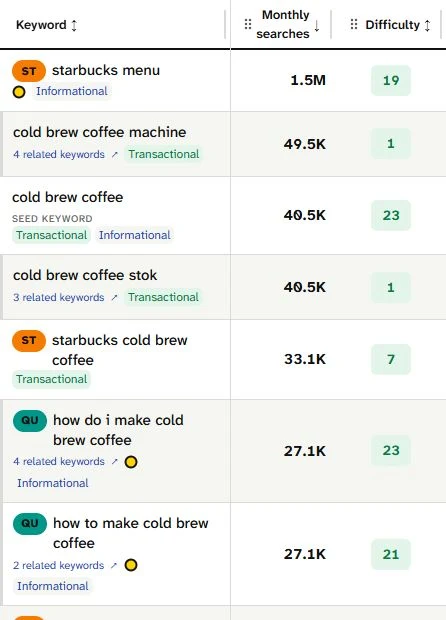
Read the wording beside Monthly searches. The two preparation rows each show 27.1K, while machine and coffee-chain rows appear in the same set. A full table can contain several kinds of task, and repeated preparation wording adds no separate breadth.
Keep the different tasks visible during this first check. A menu query, a machine purchase and a preparation question all contain coffee language, but they would make different promises for your blog.
Close wording needs another check. cold brew coffee recipe and how to make cold brew coffee at home can belong to the same preparation problem. Counting both as separate reasons to start a site would exaggerate its breadth. The keyword-grouping guide explains the phrase-level grouping method.
Decide: which searches belong to your proposed promise, and which simply share its words.
3. Look for Different Continuing Problems
Now ask whether the preparation subject has more to do than repeat one basic recipe. Use representative rows to name the reader's choices, then distinguish those choices from extra wording.
Reader problem suggested by the actual row | Representative search | Monthly searches / difficulty, United States | Subject check |
|---|---|---|---|
Learn the basic preparation process |
| 12,100 / 6 | Core preparation problem |
Understand ingredient proportions |
| 9,900 / 2 | A measurement problem related to preparation |
Prepare it with particular equipment |
| 22,200 / 0 | An equipment-conditioned method; the row has both Informational and Transactional tags |
These are possible parts of a continuing preparation subject. They involve different choices: what to do, what to measure and how the setup changes the process. cold brew coffee recipe, at 18,100 monthly searches and difficulty 19, adds wording to the first problem.
The current results for these informational and mixed queries still need inspection before choosing pages; this table tests possible subject breadth. Keep that pending check in the download rather than turning a tag into a claim about the pages ranking today.
Try the same distinction with your subject. If every row needs the same answer, you may have one good post. If related rows require different useful answers, move on to the material those answers require.
Decide: whether the sample suggests continuing problems, rather than several titles for one answer. Cold-brew preparation merits a capability check.
4. Check the Material You Can Keep Producing
Searches tell you what people ask. Your next job is to identify what you can show them repeatedly. Record your available references separately from your original observations.
For this candidate, public references include OXO's brewer instructions and Serious Eats' recorded preparation methods, checked on October 6. The latter describes coffee/water measurements, brew time, dilution, handling and cleanup. These are concrete kinds of material behind the subject, without adopting the publisher's product recommendations.
Think through each continuing problem. A walkthrough needs your actual setup and process observations. A ratio explanation needs clear units, quantities and the preparation context. An equipment-specific method needs the equipment you describe and an account of its use. One successful demonstration would not automatically provide all three.
The example currently has search data and attributed references; the writer's own brew records, equipment access and experience remain unknown. Its next decision is therefore a small feasibility test.
For your own subject, write what you already have: experience you can explain, material you can document, people or resources you can access, and work you would have to learn. Be specific enough to see the continuing effort. “I enjoy coffee” is useful motivation, but it leaves the preparation material unstated.
Decide: which parts of the promise you can support now, which need a practical test and which you should leave out.
5. Set the Boundaries Before Expanding
Nearby demand can pull a subject away from its purpose. The cold-brew set includes cold brew coffee oxo and top-rated cold brew coffee maker. In the October 6 selected results, the branded search includes official product pages and reviews; the commercial search mixes comparisons, community discussions and retail destinations.
That is a useful boundary for a preparation subject. Choosing equipment creates different continuing work from explaining how to prepare a drink. A comparative equipment promise would require relevant products and original comparison material. Keep it on hold while that material is absent.
The set also includes how much caffeine is in cold brew coffee. A preparation log records what you did; it does not supply a quantified caffeine or health answer. Leave that promise outside the current scope until you have the relevant support.
Some exclusions follow the reader promise even when you know the subject. Coffee-chain menus do little to explain a home preparation process. Their presence in the set can help you draw a boundary instead of enlarging the proposed blog.
Decide: the continuing problems you will cover and the nearby promises you will exclude or hold.
6. Choose Test, Narrow or Hold
Bring the subject and material checks together. The filled download uses these scope choices:
Scope choice | Decision | Reason |
|---|---|---|
Home cold-brew preparation and practical measurements | Test | The sample suggests related problems; check that you can produce useful original preparation material |
Instructions for one brewer only | Narrow reference scope | A documented answer may be useful, but one instruction task does not establish a continuing independent subject |
Comparative equipment recommendations | Hold | Product access and original comparison material have not been supplied |
Quantified caffeine or health coverage | Exclude from this promise | This needs different supporting material from a preparation record |
For the core preparation candidate, the test is conditional on your ability to do the work. Prepare a small sample of the material you would rely on: a documented walkthrough and a companion measurement record, if you can perform those tasks. Record the setup, units, sources, your observations and the unanswered questions.
Then assess the subject promise. Can the same continuing work help readers with different preparation problems? Which parts would depend entirely on retelling someone else's instructions? Does a narrower promise preserve useful choices you can explain, or leave only one answer?
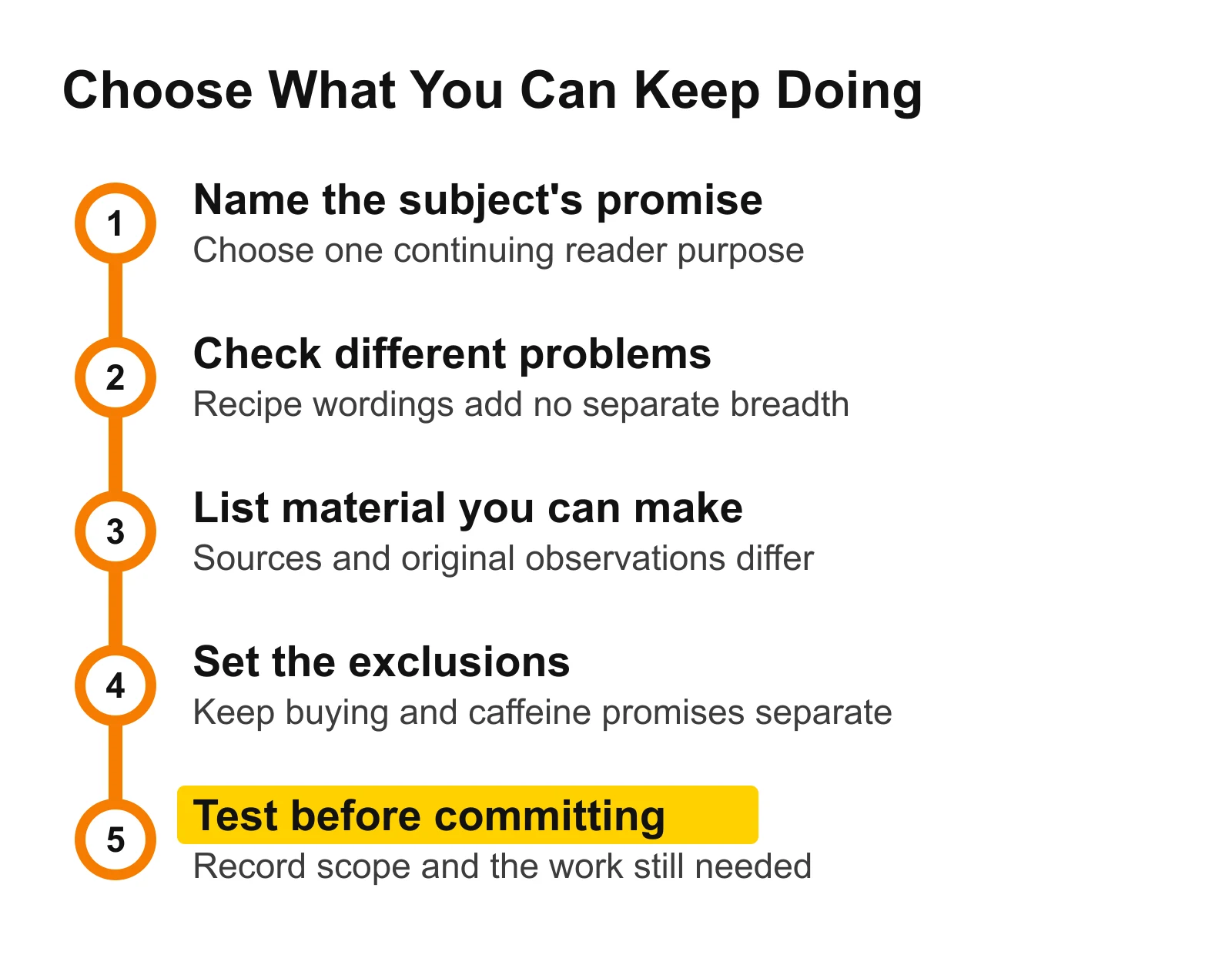
Move from the reader promise to the material behind it. The last station is a test decision: the cold-brew candidate has a possible preparation scope, while its original material and page checks still need work.
Keep the subject if the practical test supports continuing useful work, narrow it when only part of the promise is feasible, and set it aside when the core work cannot be supported. A completed test can change the decision; writing down a plan leaves the result open.
Your Next Action
Open Keyword ideas, type the subject you are considering, choose your Region, and click Search. Write one continuing promise beside the set. Then fill the scope check with different reader problems, the material you can supply, exclusions and the next test before committing to the subject.
Where to Go Next
Keyword research for bloggers: choose a first post once your subject promise is clear.
Group keywords and map them to pages: keep equivalent wording together when you start planning individual answers.
Blog content calendar: put a selected subject's topics into an order you can sustain.