- Keyword Research
- Tutorial
Reddit in Search Results: Should You Still Write the Post?
Editorial responsibility: SearchCub
Yes, you can still write the post when a Reddit, Quora or forum thread ranks for your search, as long as your post can answer the thread's question better than the thread does; if it cannot, choose a narrower search. A thread on page one suggests that many people searching want first-hand answers. It does not mean the thread is heavily linked: on the six pages below that were checked on 7 October, SearchCub's data showed no thread with more than 15 backlinks. You will see how often threads appeared, how to read a thread's row in SearchCub's Keyword overview, and how to decide between writing the post and moving on.
How often threads showed up on seven results pages
On 7 October 2026, SearchCub retrieved United States desktop results for six searches about blogging and SEO. A seventh page, for how to make cold brew coffee, was retrieved on 4 October 2026. The table lists every discussion result among their organic results, meaning Reddit threads, Quora questions and other forum threads, with the label SearchCub showed under each one.
Search | Discussion results: position, site and label |
|---|---|
| #2 Reddit r/webdev (100+ comments, 2 years ago) |
| None |
| #1 Reddit r/SEO (40+ comments, 5 years ago); #4 Quora (30+ answers, 2 months ago) |
| #3 Reddit r/SEO (10+ comments, 1 year ago); #6 Quora (30+ answers, 1 year ago) |
| #4 a thread in Google's Search Central Community, dated 13 October 2022; #8 Reddit r/SEO (10+ comments, 12 years ago) |
| #4 Reddit r/productivity (40+ comments, 4 years ago); #8 Quora (30+ answers, 1 year ago) |
| #1 Reddit r/Coffee (6 comments, 7 years ago); #4 a Homebrew Talk forum thread from 2019 |
Discussion results held 11 of the 61 organic places: six Reddit threads, three Quora questions and two other forum threads. Six of the seven pages had at least one, and on two of them a thread ranked first. No page had more than two, so the threads shared page one with articles rather than taking it over.
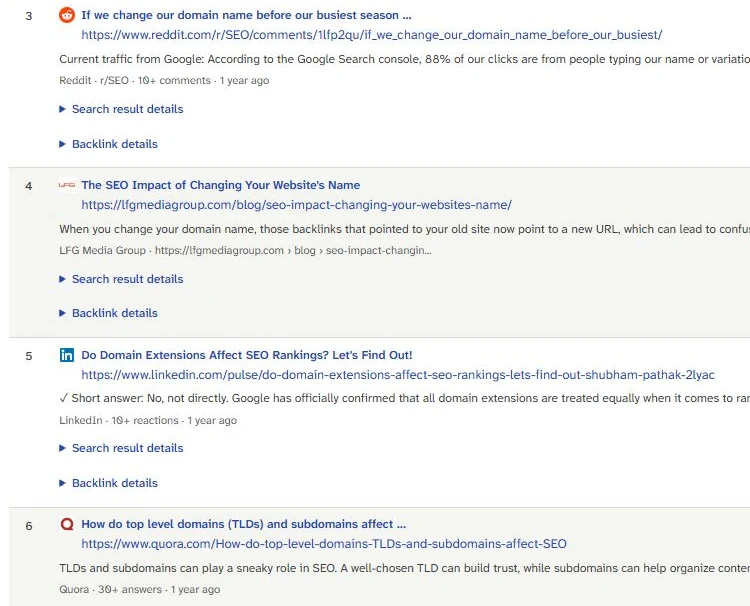
Read the grey line under each snippet. "Reddit · r/SEO · 10+ comments · 1 year ago" at 3 and "Quora · 30+ answers · 1 year ago" at 6 mark the discussions, with an article and a LinkedIn post between them. United States desktop results, 7 October 2026.
Two things stand out. The threads were not new: the Reddit ones were labelled between 1 and 12 years old. And most of them ask a specific question in a real person's words, which is the clue to what your post can add.
Why Google shows threads
Google says it shows discussions because many searchers want them. Announcing its Perspectives feature in May 2023, Google wrote that "for so many questions, you want to hear what other people have to say" (Google: more perspectives on Search). Its current documentation describes forum-style sites as places "where people collectively share first-hand perspectives", and says Google can use their markup in features "such as Discussions and Forums" (Google: discussion forum structured data).
When Google shows a block like that, SearchCub's SERP overview lists it among the result features as Discussions and forums. On 4 October 2026 that feature appeared for find low competition keywords and on page seo checklist, and the second page also showed Perspectives. Threads reach AI overviews too: the AI overview for what is seo cited the same Reddit thread that ranked second, and the ones for does domain name affect seo and content syndication seo each cited a Quora question.
The same May 2023 post listed where helpful answers can hide: a forum comment, "a post on a little-known blog" or an article that brings unique expertise to its subject. Google put the little-known blog in the same list as the forum comment. That is your opening.
Read a thread's row in Keyword overview
The worked example is seo vs ppc, the page where a Reddit thread ranked first. Follow the same steps for the search you want to write for:
Open Keyword overview. Choose Keyword, type the search (here
seo vs ppc), choose your readers' Region and click Search.Scroll to SERP overview. Beside Desktop · United States it lists the page's result features: here AI overview, People also ask and Related searches. If Discussions and forums appears, Google also showed a block of forum threads.
In Top search results for "seo vs ppc", read the grey line under each snippet. Threads carry their community and activity, such as "Reddit · r/SEO · 40+ comments · 5 years ago".
Read the four numbers on the thread's row: Domain rank, Page rank, Ref. domains and Backlinks.
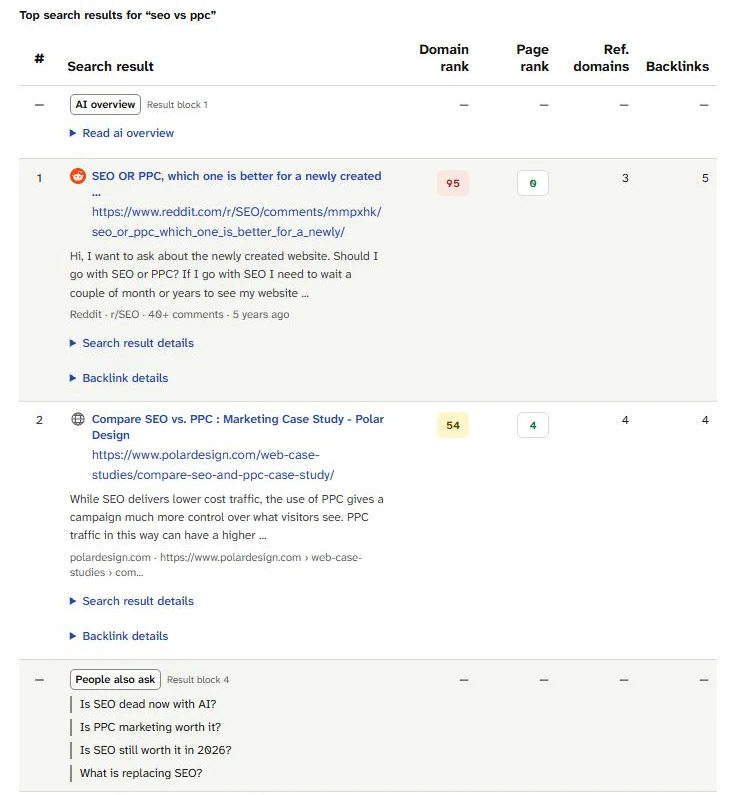
The Reddit thread in first place has Domain rank 95 but Page rank 0, with 3 linking websites and 5 backlinks. A case study follows at 2, then People also ask, which Google placed between results 2 and 3.
SearchCub defines each column in a tooltip on its heading:
Domain rank is the "relative authority of the result's overall domain, based on its links", scored from 0 to 100.
Page rank is the same score for "this specific page".
Ref. domains is "the number of distinct websites linking to this page".
Backlinks is "the number of incoming links to this page".
So the row says that reddit.com as a whole sits near the top of the scale, while the thread itself has links from three websites. Those few links are what SearchCub's data found; they cannot tell you why Google ranked the thread first.
That pattern held across the sample. Eight of the nine discussion results on the 7 October pages showed Page rank 0. So did 40 of all 54 results on those pages, though, so a low page score was common there rather than a mark of threads.
What the threads shared was a very strong site: Domain rank 95 for every Reddit row, 85 for every Quora row and 100 for Google's help community. You cannot borrow reddit.com's score, but in SearchCub's data the threads themselves had at most 15 backlinks each on the 7 October pages.
Read what the thread asks
The title and snippet show what the person wanted. The seo vs ppc thread comes from the owner of a newly created website, who asks "Should I go with SEO or PPC?" and says SEO would mean waiting a couple of months or years. The Quora question at 4 asks something different: "If you've tried both SEO and PPC, which one has worked better for your business, and why?"
Those are two needs. The first wants a decision for a new site, which a clear post can give. The second wants first-hand results, which only someone with results can give. People also ask adds four more questions, including "Is PPC marketing worth it?" and "What is replacing SEO?".
Then check Related searches at the bottom of the table:

Two related searches closed this page: "Seo vs ppc reddit" and "Seo vs ppc cost". The first is the same search plus the word reddit: a search for the threads themselves.
That reddit wording can be tiny next to the plain search. In SearchCub's keyword set for cold brew coffee ratio (United States, 4 October 2026), the plain search had about 9,900 searches a month and cold brew coffee ratio reddit had 10. Write for the plain search, and leave the reddit wording to Reddit.
What a post can add that a thread does not
A thread has one thing a single post rarely has: many people's experiences side by side. A post can add what a thread spreads thin or leaves out:
The answer first. A thread starts with a question and scatters the answer across its replies. Put yours in your first two sentences.
A current answer. The
content syndication seothread at 8 was labelled 12 years old, and its snippet reads "If you're small site you can be penalized for duplicate content". Check an old claim like that against current documentation before you repeat it or argue with it.Your own example. Screenshots, numbers or results from your own site, shown step by step.
A decision. A table or checklist that turns the replies' opinions into a choice the reader can make.
Google's guidance on helpful content asks the same of you. It asks whether your page offers substantial value next to the other pages in the results, and whether it shows "first-hand expertise and a depth of knowledge" (Google: creating helpful content). It also asks: "Are you mainly summarizing what others have to say without adding much value?" A post that rewrites the thread's replies fails that question.
Decide: write, add your results, or choose another search
Use this list with the thread in front of you:
The thread asks for a decision, like the new site owner choosing between SEO and PPC. What it suggests: searchers want an answer; the thread offers opinions. Do this: write the post, with the answer in the first lines and your reasoning shown on a real example.
The thread is old, like the 12-year-old
content syndication seothread. What it suggests: nothing newer had replaced it in those results on the day it was checked. Do this: write a current answer that covers the thread's question.The question asks for results, like "which one has worked better for your business". What it suggests: searchers want first-hand reports. Do this: write only if you have your own results; otherwise choose a search your knowledge answers.
The thread covers a narrower case than the search, like the domain thread about changing a name before a busy season. What it suggests: the general question is still open. Do this: write the general answer and give the narrow case one section.
The related searches add "reddit", like "Seo vs ppc reddit". What it suggests: some searchers want the threads themselves. Do this: write for the plain search, not the reddit wording.
Threads fill most of page one. What it suggests: searchers want discussion rather than articles. Do this: choose a narrower search.
None of the seven pages reached that last item: the most threads on any one page was two.
The seo vs ppc page fits the first item. A thread asked for a decision, and a Quora question, four comparison guides, a case study, a LinkedIn post and a research paper filled the rest of page one. SearchCub's answer to that search is SEO vs PPC: decide keyword by keyword, which works through the choice one keyword at a time with real numbers.
The does domain name affect seo page fits the fourth item. Its threads asked about changing a domain name and about top level domains and subdomains, while articles from sites with a Domain rank between 15 and 42 held five of its nine places, including the first two. Does your domain name affect SEO is the general answer written for it.
What seven results pages cannot tell you
These are seven pages from one country and one device, each checked once, and a thread's place can change from week to week. They show which pages ranked and what links SearchCub's data found for them, not why Google ordered them that way. Use the counts as a reason to look closely at your own results page, then decide on the page in front of you.
Your next step
Open Keyword overview, search for the post you plan to write next and scroll to SERP overview. Mark each thread in Top search results, read its question and its four numbers, and run it through the list above. To choose which search to write for in the first place, see keyword research for bloggers; to read the other result types on the page, see search intent.