- Keyword Research
- Comparison
SEO vs PPC: Decide Keyword by Keyword
Editorial responsibility: SearchCub
SEO earns unpaid clicks from search results over months; PPC (pay-per-click advertising) buys clicks now, and you pay for every one. So the useful question is not which one is better, but which one fits each keyword on your list. By the end of this post you will be able to sort a real keyword list into four piles: write a post, run an ad, do both, or do neither. You will use three numbers that SearchCub's Keyword ideas shows on every row: monthly searches, difficulty and CPC.
The difference at a glance
What you spend. SEO: Time: writing and improving pages. PPC: Money: you pay for each click on your ad.
When clicks start. SEO: Once your page is crawled, indexed and ranks, which can take months. PPC: As soon as your ad runs and wins its auction.
When clicks stop. SEO: While the page keeps ranking, clicks keep coming without a fee. PPC: When the budget stops, the clicks stop.
What you control. SEO: Your page, not its position. PPC: Your bid, budget and ad.
Two rules from Google sit behind that comparison. Google "doesn't accept payment to crawl a site more frequently, or rank it higher", so the unpaid results cannot be bought (How Google Search works). On the ads side, Google defines cost-per-click (CPC) bidding as paying for each click on your ads, and says your actual cost per click is often lower than the maximum you bid (Google Ads Help: CPC). Timing differs too: Google's own guide says some SEO changes take effect in hours and others take several months (Google SEO Starter Guide).
What people searching "seo vs ppc" want
The search itself shows the question people bring. seo vs ppc has about 390 searches a month in the United States, difficulty 15 and both Commercial and Informational intent tags in SearchCub, an estimate last updated on 13 September 2026. ppc vs seo shows the same 390 searches: one question in two word orders, so one page.
Its SERP overview, checked for United States desktop results on 7 October 2026, listed nine organic results under an AI overview. The first was a Reddit thread from the owner of a newly created website asking "Should I go with SEO or PPC?". Below it came a marketing case study, four comparison guides with titles such as "SEO vs PPC – Which Should You Use?", a research paper, a Quora question asking business owners which worked better, and a LinkedIn post. Almost every title treats it as one choice for a whole business. This post makes the choice one keyword at a time, with numbers you can check yourself.
People also asked four questions:
Question people also asked | Where this post answers it |
|---|---|
Is SEO dead now with AI? | Below the table: Google says SEO best practices still apply to its AI features |
Is PPC marketing worth it? | Step 3: it depends on the keyword, and the CPC column tells you the price |
Is SEO still worth it in 2026? | Step 3, keyword by keyword |
What is replacing SEO? | Not covered here; see the link below |
On the AI questions, Google says its SEO best practices remain relevant for its generative AI features in Search (Google: optimizing for generative AI features). SEO vs AI search optimization covers what changes and what stays the same.
The example: the keyword list for "seo vs ppc"
The worked example is the list SearchCub returns for this search. In Keyword ideas, choose Keyword, type seo vs ppc, choose United States as the Region and click Search. On 7 October 2026 that loaded 63 related searches. Picture a small marketing consultancy with a blog deciding what to do with them. Every number below comes from that one lookup, and every number is a SearchCub estimate for the United States, not anyone's analytics.
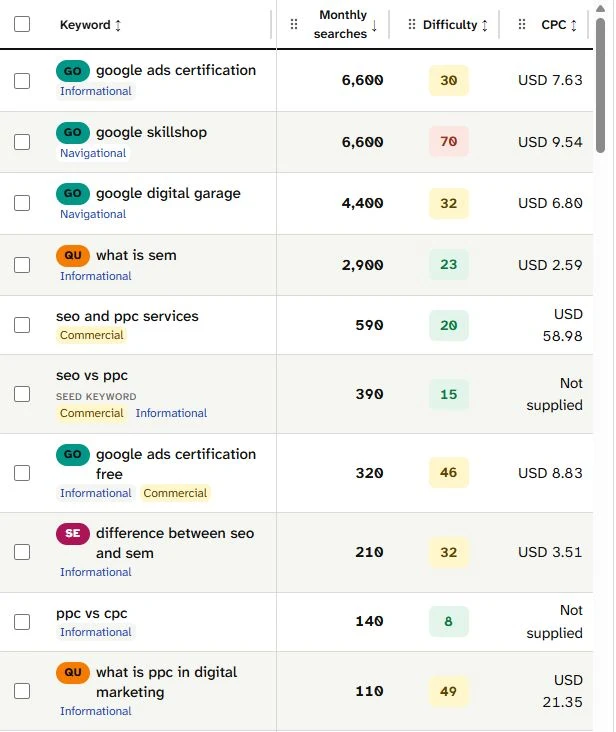
The first ten rows, sorted by monthly searches. Read each row left to right: how many people search it, how hard the unpaid result is, and what advertisers pay per click. seo and ppc services costs advertisers about USD 58.98 a click, what is sem draws 2,900 searches a month at USD 2.59, and seo vs ppc itself shows CPC Not supplied.
Step 1: Read the three numbers on each row
Each row carries the three numbers this decision needs, plus an intent tag.
Monthly searches is SearchCub's estimate of an average month's searches in the region you chose. It tells you whether enough people ask.
Difficulty is a 0 to 100 estimate of how hard it is to rank in the unpaid results. SearchCub calls anything under 30 Easy.
CPC is SearchCub's estimated average cost per paid-ad click, in US dollars, for that keyword and region. A high CPC means advertisers expect clicks on that search to be worth money to them. When the data has no estimate, the cell says Not supplied. That is unknown, not free.
The intent tag says what the searcher wants: Informational (to learn), Commercial (to compare before buying), Transactional (to buy) or Navigational (a particular site).
Step 2: Decide with four piles
Sort each row into one of four piles:
Informational, difficulty under 30. Pile: Post. Readers want an explanation, and an easy search can earn unpaid clicks.
Commercial or Transactional, high CPC. Pile: Both. A page that answers it for the long run, plus an ad if you need clients this month and can pay the CPC.
Navigational, aimed at another company's site. Pile: Neither. The searcher wants that site, not yours.
Informational but hard, or a rewording of another row. Pile: Later, or a section. Add it to the post that answers the same question.
Same-meaning rows belong on one page. Two searches that ask the same thing in different words get one post, not two, whatever the numbers say.
Step 3: Apply it to the example
Here are the ten rows with their piles:
google ads certification. Monthly searches: 6,600. Difficulty: 30. CPC: USD 7.63. Intent: Informational. Pile: Neither, unless you teach the course.
google skillshop. Monthly searches: 6,600. Difficulty: 70. CPC: USD 9.54. Intent: Navigational. Pile: Neither.
google digital garage. Monthly searches: 4,400. Difficulty: 32. CPC: USD 6.80. Intent: Navigational. Pile: Neither.
what is sem. Monthly searches: 2,900. Difficulty: 23. CPC: USD 2.59. Intent: Informational. Pile: Post.
seo and ppc services. Monthly searches: 590. Difficulty: 20. CPC: USD 58.98. Intent: Commercial. Pile: Both.
seo vs ppc. Monthly searches: 390. Difficulty: 15. CPC: Not supplied. Intent: Commercial, Informational. Pile: Post.
google ads certification free. Monthly searches: 320. Difficulty: 46. CPC: USD 8.83. Intent: Informational, Commercial. Pile: Neither.
difference between seo and sem. Monthly searches: 210. Difficulty: 32. CPC: USD 3.51. Intent: Informational. Pile: A section of the "what is sem" post.
ppc vs cpc. Monthly searches: 140. Difficulty: 8. CPC: Not supplied. Intent: Informational. Pile: A section of the "what is sem" post.
what is ppc in digital marketing. Monthly searches: 110. Difficulty: 49. CPC: USD 21.35. Intent: Informational. Pile: A section of the "what is sem" post.
Read the piles back and the plan is short. One explainer answers what is sem, with sections for the three rewordings around it. One comparison post answers seo vs ppc, where difficulty 15 makes an unpaid result realistic. One service page answers seo and ppc services. At about USD 58.98 a click, an ad on that row only makes sense if one new client is worth many clicks. And nothing goes to the four Google course and brand searches, because those searchers want Google's own pages.
Notice what the CPC column did. It did not decide the informational rows, because readers who want a definition are not buying. It decided the one commercial row: the price tells you what a paid click costs before you spend anything.
Step 4: Check the results page before you pay
Numbers on a row describe the search. They do not show who you would compete with. Click a row to open its Keyword analysis, then scroll to its SERP overview:
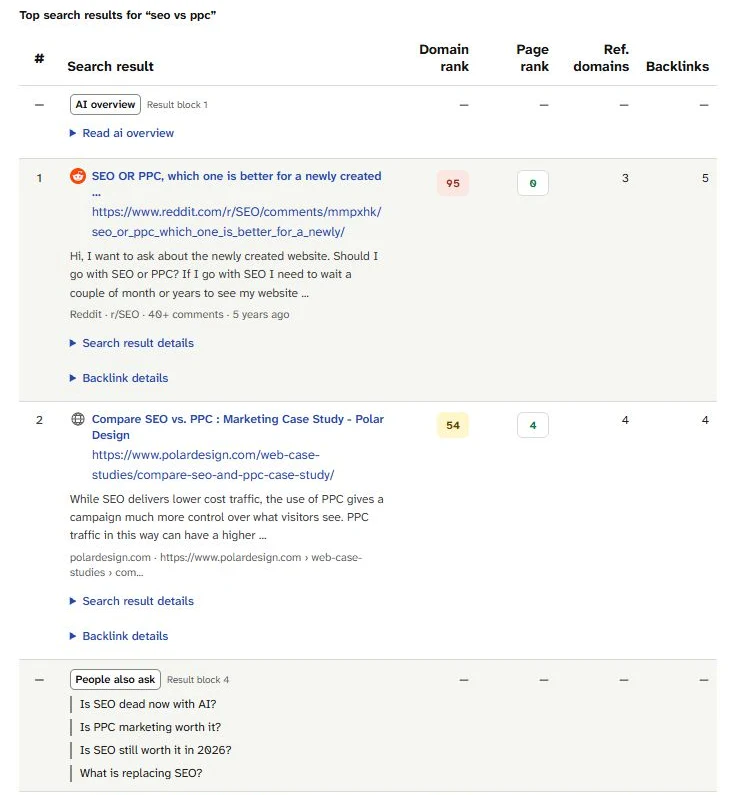
Under the AI overview, the first result is a five-year-old Reddit thread from a new site owner asking which to choose, and the second is a marketing case study. A discussion and a case study at the top suggest room for a clear, direct answer, and the People also ask block lists the questions it should cover.
Do this for every row in your Post and Both piles. If the results for a row are all pages from large brands, treat it as harder than its difficulty suggests and move it later. If they are forums and personal posts, a clear answer has room. Search intent explains how to read the result types.
What these numbers cannot tell you
CPC is an average of what advertisers paid; your own actual cost depends on your bids and each auction. Difficulty and searches are estimates for one country and do not predict that a page will rank. Neither number knows what a click is worth to your business, so set that value first.
Your next step
Open Keyword ideas, search the main topic of your site, and sort by CPC: High to Low. Mark each row Post, Both, Neither or Section, and start with the easiest row in your Post pile. For choosing which post to write first, see keyword research for bloggers, and for weighing demand against difficulty, search volume vs keyword difficulty.