- Content Planning
- Tutorial
Traffic Value in SEO: What the Dollar Figure Means
Editorial responsibility: SearchCub
Traffic value is an estimate of what a website's unpaid search visits would cost if it had to buy the same clicks as search ads. It is a price tag on visits, not income. By the end of this post you will be able to read Traffic value (USD) in SearchCub's Domain overview, say what it means for one real blog, and use it to compare the commercial weight of the topics on your own site.
What traffic value measures
Two estimates go into it. Each search a site ranks for sends it an estimated number of visits a month. Each search also has a cost per click (CPC), the average amount advertisers pay when someone clicks their ad for that search. In Google Ads, cost-per-click bidding "means that you pay for each click on your ads" (Google Ads Help: CPC).
Traffic value multiplies the two for every search and adds up the results. Domain overview's figures come from DataForSEO, a search data company, whose documentation says the metric indicates "the cost of driving the estimated volume of monthly organic traffic through PPC advertising in Google Search" (DataForSEO: domain rank overview). PPC, or pay-per-click, is advertising where you pay for each click.
SearchCub's own help text on the Pages tab is clear about what the number is not: "Estimated equivalent monthly advertising cost of this page's organic search traffic, in US dollars. This is not revenue or actual spend."
One derived number makes the figure useful. Divide traffic value by the estimated visits behind it and you get the average CPC of the searches that bring those visits, weighted by how many visits each one sends. This post calls it value per visit. A high value per visit means the visits arrive from searches that advertisers pay a lot to win.
Read Traffic value for a real site
The worked example is productiveblogging.com, a blog about blogging, looked up in SearchCub for the United States. The summary card was read on 4 October 2026, and the monthly history and page list come from the same site's saved result of 3 October. Every figure is an estimate from search data, and no affiliation is implied.
Open Domain overview, choose Domain, type
productiveblogging.com, choose United States as the Region and click Search.On the Overview tab, read the Latest estimates card.
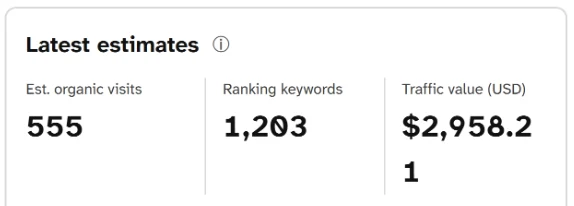
Three figures, three questions: 555 is how many visits a month search is estimated to send, 1,203 is how many searches the site ranks for, and $2,958.21 (the card wraps its last digit) is what those visits would cost as ads.
For the example, $2,958.21 divided by 555 visits is about $5.33 a visit. That is the site-wide value per visit, the benchmark to hold each page against later.
Next, open the Search estimates tab and read two rows of Organic search estimates together: Visits and Value (USD).
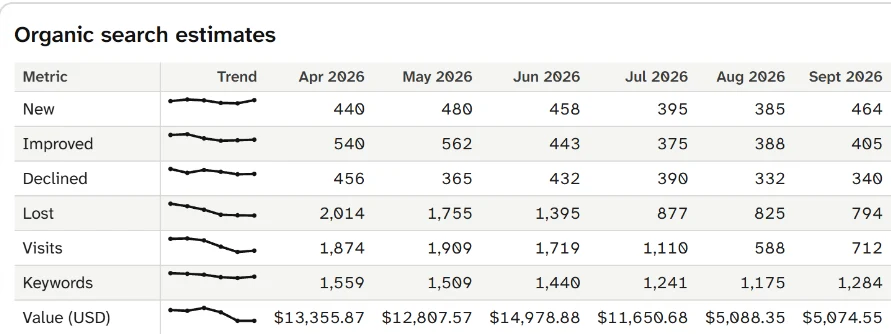
Read Visits and Value (USD) as a pair. From May to June, estimated visits fell from 1,909 to 1,719 while value rose from $12,807.57 to $14,978.88. From August to September, visits rose from 588 to 712 while value held level at $5,088.35, then $5,074.55.
The two rows move apart because value depends on which searches bring the visits and on what advertisers pay for them, not only on how many visits there are. Value per visit was about $6.71 in May, $8.71 in June and $10.50 in July. Either more of the visits came from expensive searches, or the same searches cost advertisers more; the monthly rows alone do not separate the two. So traffic value can rise while visits fall, and you should never read it as a visit count.
Finally, open the Pages tab. Each row shows one page's Estimated monthly organic visits and Traffic value (USD), among other columns. The example's table lists 25 pages with traffic estimates; here are nine of them, with value per visit worked out from the two figures shown (the visits are displayed as whole numbers, so treat value per visit as approximate):
/make-money-with-mediavine-ads/. Estimated monthly organic visits: 22. Traffic value (USD): $692.73. Value per visit: $31.49.
/start-a-successful-wordpress-blog/. Estimated monthly organic visits: 22. Traffic value (USD): $419.45. Value per visit: $19.07.
/everything-you-need-to-know-about-journey-by-mediavine/. Estimated monthly organic visits: 12. Traffic value (USD): $220.26. Value per visit: $18.36.
/beginners-guide-seo/. Estimated monthly organic visits: 30. Traffic value (USD): $357.73. Value per visit: $11.92.
/best-blogging-tools/. Estimated monthly organic visits: 16. Traffic value (USD): $138.22. Value per visit: $8.64.
/how-do-blogs-make-money/. Estimated monthly organic visits: 42. Traffic value (USD): $127.28. Value per visit: $3.03.
/blogging-explained/. Estimated monthly organic visits: 83. Traffic value (USD): $137.18. Value per visit: $1.65.
/google-calendar-hacks/. Estimated monthly organic visits: 23. Traffic value (USD): $13.04. Value per visit: $0.57.
/helpful-content-update/. Estimated monthly organic visits: 20. Traffic value (USD): $0.06. Value per visit: under 1 cent.
Sorting by visits and sorting by value give two different lists. The five pages with the most visits bring 214 of the 25 pages' 480 visits, but only $745.05 of their $2,603.96 in traffic value. The five pages with the most value hold $1,828.39 of it. Only the beginner's SEO guide makes both top fives.
Per-page values live on this tab. Page analysis, the tool for a single address, leaves traffic value unavailable for an exact page, so start from the domain's Pages list even when you care about one page.
Use traffic value to compare the commercial weight of topics
Commercial weight here means how much advertisers pay for the searches a page or topic ranks for. Value per visit measures it, and it sorts a blog's topics in a way visits cannot.
On the example blog, the page about making money with Mediavine ads (about $31 a visit), the guide to starting a WordPress blog (about $19) and the page about Journey by Mediavine (about $18) carry the most commercial weight, several times the site-wide $5.33. The explainer about blogging brings the most visits of all, 83 a month, but at about $1.65 each it sits well below that benchmark. At the far end, the Google Calendar page brings 23 visits at about $0.57 each, and the page about the helpful content update brings 20 visits valued at $0.06 in total.
When commercial topics matter to your plans, use this list to decide what each kind of page on your own site is for:
High value per visit, few visits. What it tells you: the page ranks for searches advertisers pay for, but few people reach it. What to do with it: a candidate to improve first: the searches it already ranks for carry commercial weight.
Many visits, low value per visit. What it tells you: popular searches that advertisers pay little for. What to do with it: judge it by its readers and what they do next, not by this figure.
Many visits and high value per visit. What it tells you: popular and commercial at once. What to do with it: check it first after any change to your site.
Value at or near zero. What it tells you: the searches carry almost no CPC in the data. What to do with it: leave this figure out of the decision.
For a topic you have not written yet, apply the same idea one keyword at a time. The CPC column in Keyword ideas shows what advertisers pay for each search before you write, and SEO vs PPC sorts a real keyword list that way. If you want to weigh CPC against demand and difficulty, search volume vs keyword difficulty covers the other two numbers.
What traffic value is not
Keep it apart from four figures that can sound similar:
Visits. Traffic value is a dollar figure. Count visits with Est. organic visits, which rose from August to September while value held level.
Income. In SearchCub's words, "This is not revenue or actual spend." A site can run no ads and sell nothing, and its traffic value stays the same.
What the site is worth. The figure prices search visits as ad clicks. It says nothing about the site's earnings or costs.
Conversions. It does not count the readers who subscribe, buy or sign up. Your own analytics is where those are recorded.
Three things to keep in mind
Both inputs, visits and CPC, are estimates for one country, so treat value per visit as a way to rank your own pages against each other rather than as a dollar amount anyone pays. A page with few ranking searches can swing on just one of them: the Mediavine ads page ranks for 6 searches, so a single position change could move much of its value. And the Latest estimates figure has no observation month, so $2,958.21 and September's $5,074.55 are two separate estimates, not a fall from one to the other.
Your next step
Open Domain overview, search your own domain with the Region where most of your readers live, and open Pages. Use Download top pages to save the list as CSV or Excel, add one column, Traffic value (USD) divided by Estimated monthly organic visits, and sort by it. Compare its top five with the top five by visits, then pick one page with a high value per visit and few visits to improve first. For the visits this figure is built on, read what is organic traffic; for the basics behind both, start with what is SEO.