- Informational
Search Volume vs Keyword Difficulty: Choose the Next Page
Editorial responsibility: SearchCub
Search volume estimates demand; keyword difficulty estimates how hard it may be to rank. Choose a keyword with enough relevant demand to justify an article and competition your site can realistically take on.
1. Compare monthly search demand
In SearchCub, choose Keyword, enter a topic, choose your Region, and run Search keywords. Start with keyword research, then try an audience-specific phrase such as keyword research for bloggers if the results are too broad. Keep the same region when comparing candidates.
In our United States search on 13 September 2026, the blogger query returned both of these rows:
Candidate | Monthly searches | Difficulty | CPC | Initial decision |
|---|---|---|---|---|
keyword research | 246K | 88 | USD 18.83 | Broad demand; investigate whether the topic and competition fit. |
keyword research for bloggers | 320 | 54 | USD 9.45 | Clear audience fit for a blogger tutorial; inspect its ranking pages. |
Monthly searches is the supplied average monthly demand estimate, visible in the keyword table. It is not a forecast of visits to your article. Click the keyword to inspect its search history before treating a large number as steady demand. Our captured history covered August 2025–July 2026 and fluctuated substantially for the broader phrase.
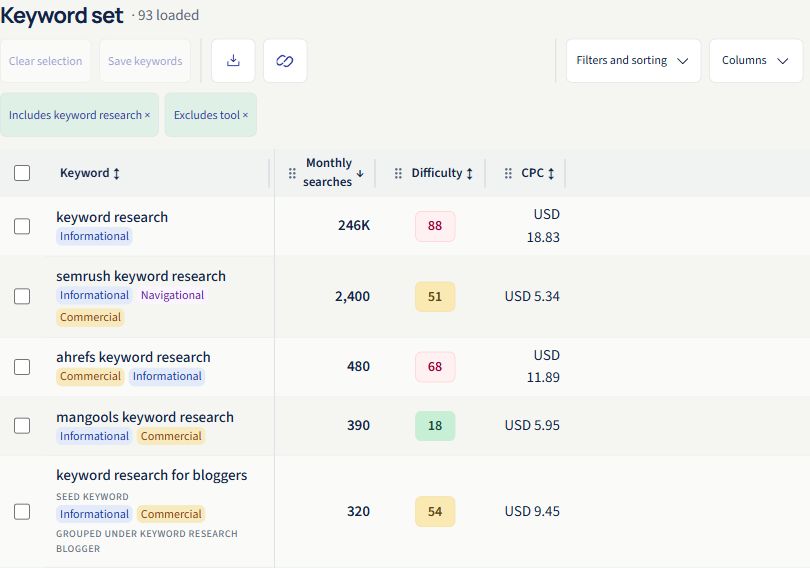
Use Filters and sorting to narrow the list. Here we included “keyword research” and excluded “tool”; Columns keeps Monthly searches, Difficulty and CPC in view.
For a specialist tutorial, 320 searches can represent a more relevant audience than 246K broad searches. There is no universal minimum volume: decide whether reaching this audience would make the article worth producing.
2. Use difficulty to compare the challenge
Read Difficulty beside each keyword, or open its analysis. This supplied score runs from 0 to 100; a higher score indicates a harder estimated organic ranking challenge. It is separate from paid advertising competition.
Look through the returned Keyword set for a related phrase with lower difficulty. Here, 54 makes the blogger phrase a more approachable candidate than the broader phrase at 88. It does not promise a ranking. Use that difference to prioritize the next inspection, rather than treating a score below a chosen cutoff as approval to write.
Treat Not supplied as unknown, not zero. A missing difficulty score cannot qualify a keyword as easy. It just means there isn't sufficient data to make a judgment.
A harder keyword can still deserve the effort when its audience is highly relevant, the potential value is realistic, and you can create and maintain an answer that competes with the existing pages. That judgment needs the next step.
3. Inspect the pages you would compete with
Click the keyword text, then open SERP overview and check its country and device. Scan the organic titles and URLs, then open relevant destinations to assess the reader's task, page format, and depth. See the SERP analysis walkthrough for a fuller inspection.
Our blogger query's United States desktop results included tutorials, a keyword-tool page, and discussion. We opened Productive Blogging's guide, HostPapa's blog-post tutorial, and Semrush's tool page. These support both learning and tool-use tasks. A blogger tutorial should therefore teach a usable process with an actual example, rather than just define keywords.
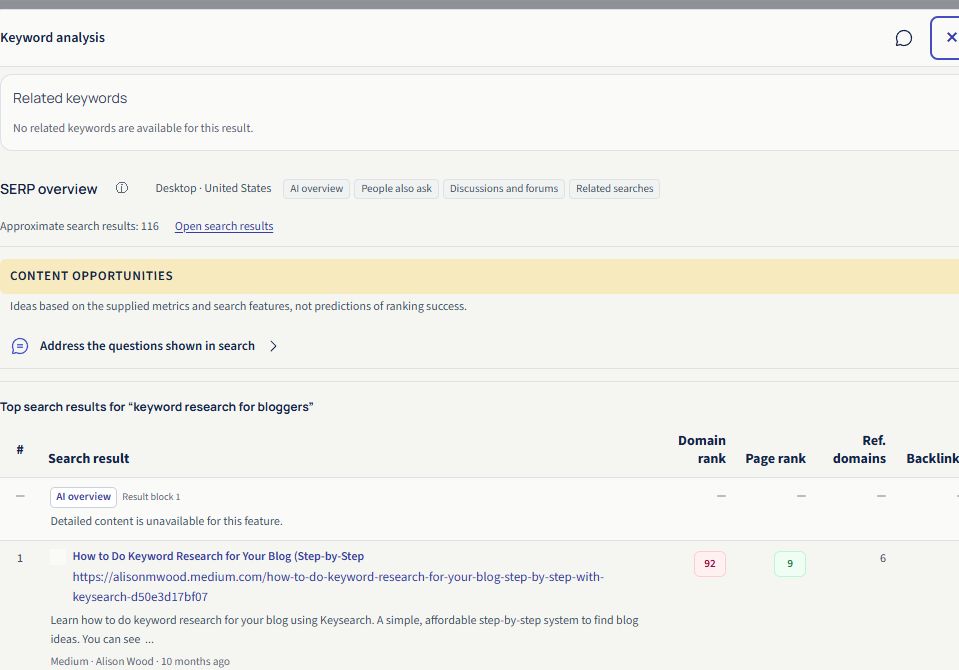
Use the returned pages to decide what your answer needs to accomplish.
We did not inspect the broader phrase's SERP in this example. Its larger volume alone cannot establish that a blogger tutorial would fit those results.
4. Put CPC in context
CPC, shown in the table and keyword analysis, is an estimated average paid cost per click. Our blogger candidate's USD 9.45 is lower than the broader candidate's USD 18.83; neither figure estimates what your organic visitors will earn you.
Use CPC as context for commercial value after checking audience and organic competition. A high-volume, lower-CPC topic may suit an informational article if those readers have a relevant next step. Lower CPC does not establish that nobody bids on a phrase or that SEO will be easy. Google's keyword statistics explanation also distinguishes advertising competition from search demand.
5. Choose, save, and record the reason
For a blogger-focused tutorial, choose keyword research for bloggers for the next brief: the audience is explicit, difficulty is lower, and the inspected results support instruction. Reconsider if you cannot contribute a useful process or example. The broader phrase remains a separate research candidate.
Use the filled comparison as a model, then record your candidates, reviewed URLs, decision, and what would change your choice in the blank comparison worksheet.
Select the keyword’s checkbox and choose Save keywords to keep it, or Download → Selected rows → CSV to export it. Keep your reasoning in the worksheet. The save and export steps explain the list workflow.