- On-page SEO
- Tutorial
What Is Organic Traffic? How to Read It on a Real Site
Editorial responsibility: SearchCub
Organic traffic is the visits your website gets from people who click an unpaid result on a search engine's results page. By the end of this post you will be able to tell organic visits apart from paid, direct, referral and social visits, read one real blog's organic traffic in SearchCub's Domain overview, and explain why that estimate and your own analytics give different numbers.
Organic means unpaid
A search results page mixes ads, which businesses pay for, with the ordinary results the search engine ranks by itself. Organic traffic comes only from the second kind. Google says businesses can advertise in "clearly marked ad sections", and that "because we only sell ad space, no one can buy better placement in organic Search results" (Google: ads on Search).
So organic traffic is earned rather than bought. It comes from pages that rank, and it keeps arriving for as long as they rank, with no fee for each click. Earning it is the work of SEO, which what is SEO explains from the start.
Paid search works the other way round: the advertiser pays for the clicks, and the clicks stop when the budget does. SEO vs PPC shows how to choose between the two for each keyword on your list.
Organic traffic and the other ways visitors arrive
Analytics tools sort every visit by where it came from. Google Analytics calls these groups channels, and its definitions are a useful reference even if you use another tool (Google Analytics Help: default channel group):
How the visitor arrived | Google Analytics channel | Organic search traffic? |
|---|---|---|
Clicked a non-ad result on Google, Bing or another search engine, including Google's AI Overviews and AI Mode | Organic Search | Yes |
Clicked an ad on a search engine | Paid Search | No |
Typed your address or used a saved link | Direct | No |
Clicked a non-ad link on another website, such as a blog or news site | Referral | No |
Clicked a non-ad link on a social site such as Facebook | Organic Social | No |
Clicked a link in an email | No | |
Came from an AI assistant such as ChatGPT, Gemini or Copilot | AI Assistant | No |
Two rows catch beginners out. Organic Social is unpaid as well, but it is social traffic; in this post, as in SearchCub, organic traffic means organic search traffic. And a click on a link inside Google's AI Overviews counts as Organic Search, while a visit from an assistant such as ChatGPT gets a channel of its own.
Read organic traffic for a real site in Domain overview
The worked example is productiveblogging.com, a blog about blogging, looked up in SearchCub for the United States on 4 October 2026. It is a third-party site, so every figure below is SearchCub's estimate from search data, and no affiliation is implied.
Open Domain overview, choose Domain, type
productiveblogging.com, choose United States as the Region and click Search.On the Overview tab, find the Latest estimates card. Est. organic visits is SearchCub's estimate of how many visits a month the whole site gets from Google's unpaid results in the region you chose. For the example it is 555.
Read the Organic traffic chart under it: estimated organic visits for each of the last six recorded months.
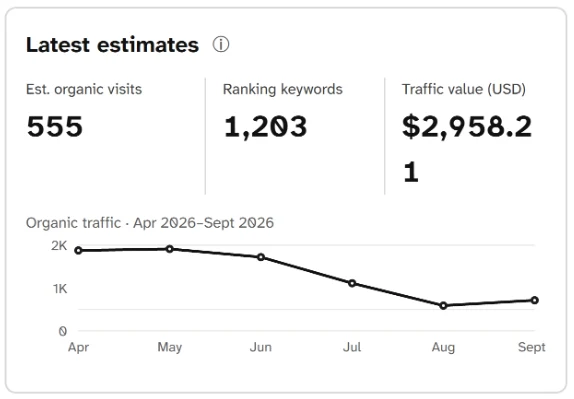
Read the line before the headline figure. Estimated organic visits sat near 2K in April and May, fell to their lowest point in August and rose slightly in September. The 555 above the chart is the latest estimate, which has no month of its own.
For the exact points, open the Search estimates tab. Its Visits row reads 1,874 for April and 1,909 for May, then 588 for August and 712 for September.
Then decide what the line means. Here, the blog's estimated organic traffic in September was well under half of its May level. If this were your site, the next job would be to find which searches lost their positions; why keyword rankings change walks through that investigation.
The card's third figure, Traffic value (USD), puts a dollar price on these visits as if they were ad clicks; it is not a count of visits or of income. Traffic value in SEO explains how to read it.
Where organic traffic comes from
A site's organic traffic is not one stream. It is the sum of many small ones, one for each search where one of its pages appears, and the position decides most of the flow.
SearchCub shows each stream in the Estimated visits column of the keyword table. Its help text describes the figure as "modelled from its ranking and search volume". Domain overview's figures come from DataForSEO, a search data company, whose documentation describes a site's total as "the product of CTR (click-through-rate) and search volume values of all keywords the domain ranks for" (DataForSEO: domain rank overview). In plain words: for each search, take its monthly searches, multiply by the share of searchers expected to click a result in that position, and add up every search.
For the example blog, the pattern is easy to see on a single page. The table below comes from its guide to keyword research for bloggers, opened in Page analysis from a saved SearchCub result for the United States, shown on 4 October 2026:
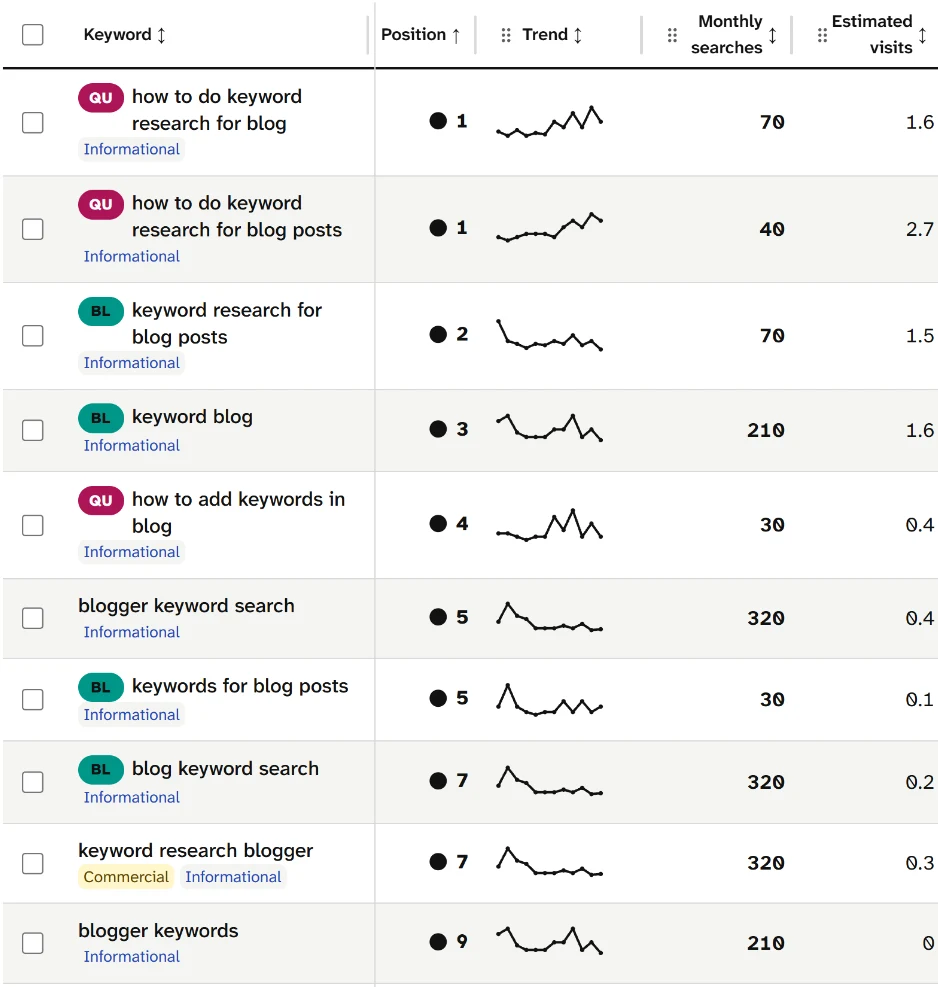
Compare the Position and Estimated visits columns. First place for how to do keyword research for blog posts, with 40 searches a month, is estimated to send 2.7 visits; the three searches ranked 7th or lower add up to 850 searches a month and send 0.5.
The four searches in the top three positions send 7.4 of the 8.8 estimated visits in this table. That is the practical lesson: a page earns most of its organic traffic from searches where it sits near the top, not from searches where it merely appears.
Across the whole site, the same column in Domain overview's keyword table shows which searches matter. blogging tools, where productiveblogging.com ranks first for 320 searches a month, shows 11.5 estimated visits, while how to start a facebook group, third for 1,300 a month, shows 9.3. A bigger search in third place can send about as much as a smaller one in first.
To see every search one of your own pages ranks for, find the keywords a page ranks for walks through Page analysis step by step.
Why the estimate won't match your analytics
Search your own domain and the number will not match the Organic Search figure in your analytics. Both can be right, because they count different things:
SearchCub's Est. organic visits | Your analytics' Organic Search | |
|---|---|---|
Search engines | Google only: the card's help text calls them "Domain-wide Google estimates" | Google, Bing and the other search engines on Google Analytics' list |
Countries | The one Region you chose | Every country your visitors come from |
How it is made | Modelled from positions and monthly searches | Visits recorded on your pages |
Searches included | The searches in SearchCub's keyword data for your site | Every search that sent a recorded visit |
Period | Latest estimates has no month; the chart and Search estimates show dated months | Whatever dates you choose |
The measured number closest to SearchCub's estimate is Clicks in Google Search Console, which Google defines as "the number of times a user clicked your site from Google Search results" (Search Console Help: Performance report). Like the estimate, it covers Google alone, and its Countries tab breaks the clicks down by country. SearchCub has no Search Console connection, so set the two figures side by side yourself.
When you size up other sites, compare like with like. SearchCub's figure for your blog against SearchCub's figure for a competitor, in the same region, is a fair comparison. Your analytics against their estimate is a comparison of two different measurements.
Decide what to do with the number
Your question | What to use | In the example |
|---|---|---|
How many visits did search send my site last month? | Organic Search in your analytics; Search Console Clicks for Google alone | Only the site's owner has these |
How big is a competitor in search? | Est. organic visits for both sites, in the same Region | 555 a month |
Is a site's search traffic rising or falling? | The Organic traffic chart and the Search estimates tab | Near 2K in April and May, lowest in August |
Which searches bring the visits? | The Estimated visits column |
|
Your next step
Open Domain overview and search your own domain, with the Region where most of your readers live. Write down Est. organic visits and the direction of the Organic traffic chart, then open Search Console's Performance report and read Clicks for the same country and month. If the line is falling, start with why keyword rankings change; if you are new to the work that earns organic traffic, what is SEO is the place to begin.