- Competitor Research
- Tutorial
Turn a competitor's strong page into a better content brief
Editorial responsibility: SearchCub
Use a competitor's page to understand the reader's task, then build a brief around your own answer, evidence and useful contribution.
Copying its headings produces another version of the same page. A useful brief explains what your reader needs to do, what information makes that possible, and what you can demonstrate independently.
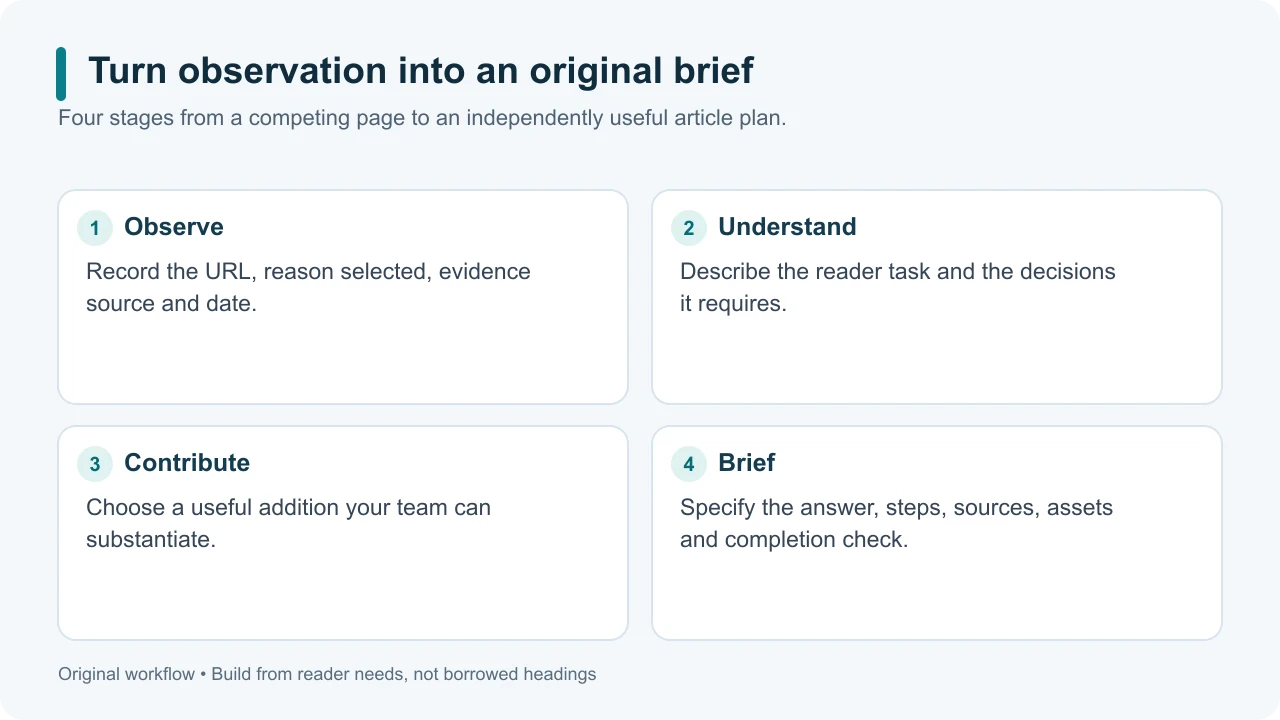
Original illustrative diagram: separate observation from what your article will contribute.
1. Explain why this page is worth studying
Record the exact URL and why you selected it. Perhaps you observed it in current results for a relevant query, or a keyword tool reported visibility for the page. Record the market, source and date.
If a report calls it a “top page,” check what the label means. Estimated organic traffic, links and your own manual assessment are different selection criteria. None gives you access to the publisher's actual visitor data.
Use page keyword research when you need to investigate a specific URL instead of the whole domain.
Read the whole page. Note the intended reader, promise, format, prerequisites and final outcome. Write those in your own words. Avoid saving a competitor's outline as your draft outline, which makes it too easy to reproduce its organization without thinking about your reader.
2. List the reader decisions
For a hypothetical article on watering indoor basil, the reader might need to decide whether the soil is dry, whether the pot drains properly and whether to change the watering routine. “Watering basil” is the topic; those decisions are the practical work.
Create a small table:
Reader decision | Information needed | Evidence we can provide |
|---|---|---|
Water now or wait? | What to check in the pot | A clear observation checklist |
Change the container? | Drainage and placement considerations | An original diagram with reliable sources |
Investigate another cause? | Limits of a watering explanation | A scoped troubleshooting path |
These are illustrative planning examples, not gardening recommendations or the results of a product test. A gardening article would need appropriate horticultural sources and real evidence before publication.
Now assess which decisions the competing page supports clearly. Distinguish “missing” from “not required.” An article does not need every adjacent topic to complete its purpose.
3. Choose one useful contribution
Pick something your team can substantiate: a reusable checklist, a worked calculation, an original comparison, an annotated real example or a clearer decision path. Prefer one strong contribution to a list of generic additions.
Google's helpful-content questions encourage original value beyond copying or rewriting sources. That supports studying a page critically rather than repackaging it. Helpful-content guidance.
Write the contribution as a concrete promise. For example: “A one-page observation worksheet that helps beginners record what they checked before changing their routine.” Do not promise that a worksheet guarantees a search position or solves every cause of a problem.
If your contribution depends on firsthand testing, put the test into the brief. Specify the inputs, method, observations and limits. An attractive hypothetical example cannot stand in for a completed experiment.
4. Build the brief from the task
Start with a direct opening answer and organize sections in the order the reader needs them. Include:
The reader, primary query group and outcome.
The existing page to refresh, or the reason a distinct URL is needed.
The answer and necessary steps, including exceptions.
Sources for factual claims and assets needed for the example.
Relevant internal links and one useful next action.
A review checklist for unsupported claims and unfinished steps.
Draft the outline from this brief, then compare it with the competing page. Similar necessary topics are normal; copied phrasing, copied illustrations and the same unexplained sequence are signs you have not done enough original work.
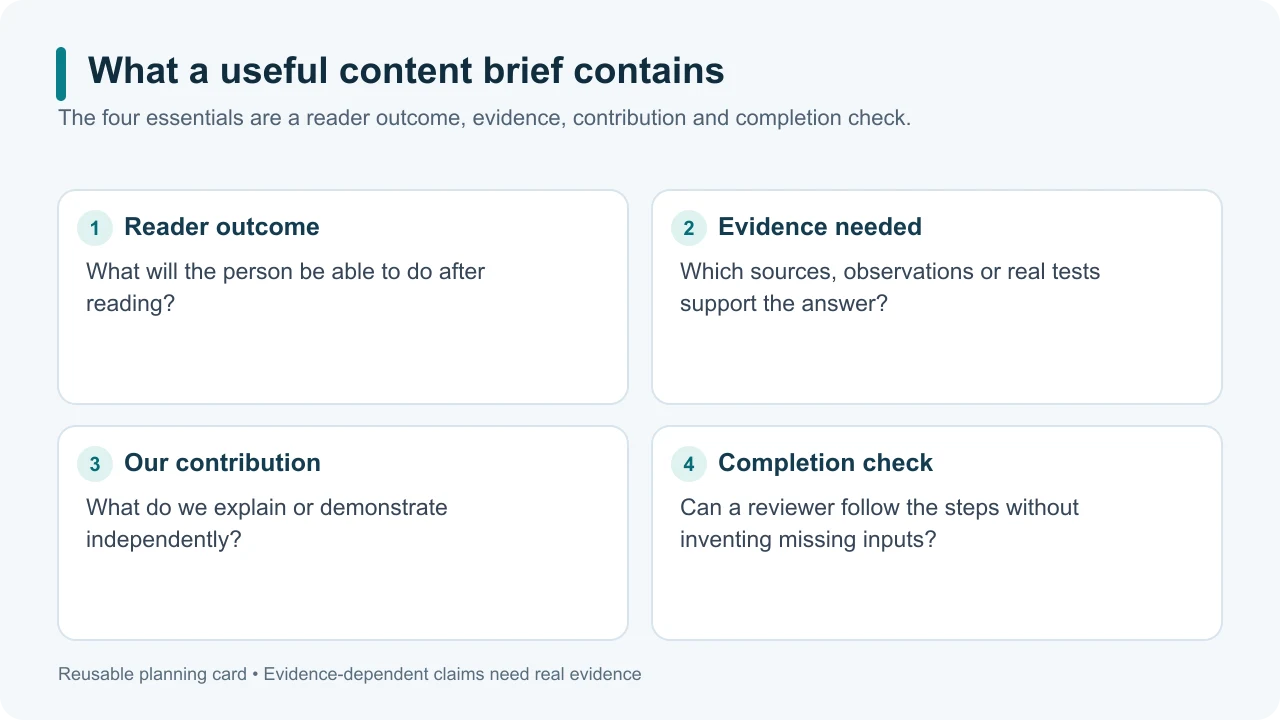
Original illustrative diagram: the brief should describe an achievable answer, not a collection of borrowed headings.
5. Check your own inventory before writing
Search your published posts and private drafts for the same reader task. A stronger checklist may belong in an existing article. Create a separate page only when its purpose is meaningfully different, such as a reusable worksheet versus a general introduction, and when a standalone page is useful to the reader.
Keep the brief's length flexible. Add enough explanation to complete the task; remove sections that merely echo the competitor. More words are not evidence of a better answer.
Check our keyword research mistakes guide when reviewing assumptions about keywords, metrics and page selection.
Finally, ask another reviewer to follow the proposed steps using only the brief's evidence. If they need to invent a missing input, assume a product feature or guess what a metric means, fix the brief before drafting.
For an SEO workflow, open SearchCub to investigate your selected query or URL. Save what you actually observe, then make that evidence part of your own article rather than presenting the competitor's success as your result.