- On-page SEO
- Tutorial
How to Check AI Overview Citations Against Their Sources
Editorial responsibility: SearchCub
Check an AI Overview citation by identifying the exact linked page, finding the statement it is meant to support, and reading that page for the relevant evidence. Record citation presence separately from source support: a listed source is not a completed fact-check.
This walkthrough uses one recorded search for seo friendly url. It finishes a source-verification worksheet rather than a plan to gain citations. If you are new to the wider search context, start with what SEO means.
Record which answer you are checking
Open Keyword overview to inspect search results. To inspect a saved SERP, reopen it from your own Research history. The public recorded keyword result identifies the example keyword record; it does not reopen its historical SERP. The screenshots below preserve the original October 7, 2026, at 04:19:08 UTC observation, United States · English · Desktop.
Keep that original observation time in your notes. Reopening the saved result or checking a source today does not make the old answer a new search observation.
The recorded answer is cached and shortened. SearchCub's warning says its citation coverage is incomplete, so a page missing from this record is not proven absent from Google. Work with the available passage; do not fill in omitted sentences from memory or another answer.
Read the explicit source list
In Keyword analysis, find SERP overview and Observed AI Overview citations. Expand Citation evidence and search context to read the market, device, observation time and exact source URLs.
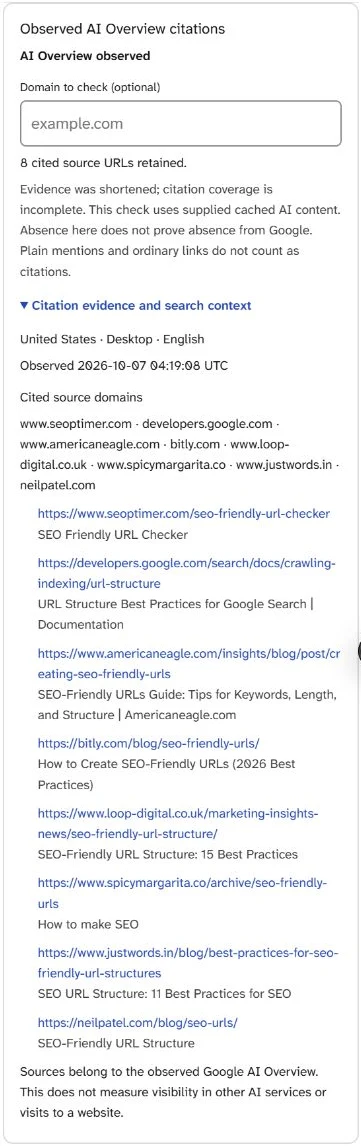
The source list belongs to this dated, shortened observation. Its eight retained URLs are not a count of all Google citations for the topic.
Copy exact URLs, not only domain names. Two pages on the same website can support different claims. Keep different URL spellings separate until you have evidence that they lead to the same relevant page; removing a parameter or changing a path by guesswork can change the source you check.
This retained list has eight distinct URLs. The saved response represents them through nineteen reference records at different levels. Those repeated records are not nineteen independent citations or nineteen separate search observations. The worksheet keeps one entry for each exact cited URL.
Separate citations from other appearances
A source can appear in several ways within the same result. In the recorded AI overview result block, open Read AI overview to inspect the available answer text and its resource links. Compare these appearances with the explicit source list.
Appearance in this retained result | What to record |
|---|---|
Google's URL-guidance page appears in the cited source list and as an ordinary resource link | One cited URL; the ordinary link occurrence adds no second citation |
SEOptimer's URL checker appears in the cited source list and as an ordinary resource link | One cited URL; whether the checker works is a separate, unperformed test |
The word Google appears in a sentence about hyphens | A plain mention, not an additional URL citation |
A Reddit discussion appears as the first organic result | An organic-result control; it is not in this retained citation set |
The Reddit row does not establish that Google never cites that discussion. Likewise, an ordinary link does not become an explicit citation merely because its destination also appears elsewhere in the answer. Preserve the type of each occurrence before counting sources.
Check one linked promise
The retained resource paragraph offers further URL-structure guidance through URL Structure Guidelines from Google Search, alongside a separate SEO Friendly URL Checker link.
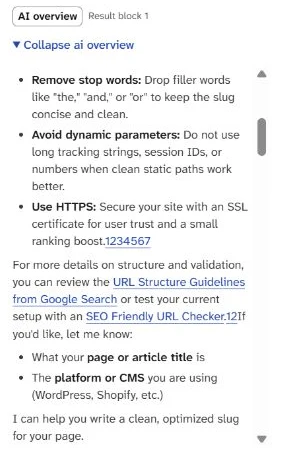
The Google destination supplies guidance. The checker link has its own destination and has not been tested in this exercise.
Follow the exact Google URL-structure page. Checked on October 8, 2026, it contains sections on descriptive URLs, word separators, parameters and case handling. In Use descriptive URLs, it says:
When possible, use readable words rather than long ID numbers in your URLs.
That supports the narrow promise that the linked resource provides URL-structure guidance. The page is documentation; this check does not establish that Google's link provides an automatic validator. The separate SEOptimer checker was not opened or tested.
Do not extend this finding to every preceding recommendation. The resource paragraph's Google link does not, by itself, attribute the earlier list of URL advice to that page. Checking a particular recommendation requires its exact wording, a defensible source association and relevant evidence in the source.
Fill the support record
For this source, the useful completed entry is:
Field | Checked entry |
|---|---|
Answer observation | October 7, 2026, 04:19:08 UTC; United States · English · Desktop |
Source | Google's exact URL-structure documentation page |
Promise checked | Further URL-structure guidance |
Source checked | October 8, 2026 |
Source's displayed update date | December 10, 2025 |
Support finding | Supported for that narrow resource promise |
Source content when the answer was generated | Unknown; no historical body snapshot supplied |
Remaining scope | Earlier recommendations and the other seven cited source pages are not checked |
The older update date does not establish what text the page contained when the answer was generated. Keep the answer observation, your later source-check date and the publisher's displayed update date in separate fields.
Download the filled citation-verification record. It contains the eight cited URLs and four separate controls: two ordinary-link occurrences, one mention and one organic result. Seven cited-source rows remain NOT_CHECKED; the single Google row has narrow support. None of the controls is promoted to another citation.
Use the blank verification record for your next answer. Record the observation context, exact source, associated passage or promise, relevant evidence, source-check date, result and next action. Leave support as NOT_CHECKED until you inspect it; use Unknown for unavailable historical content instead of assuming today's page is unchanged.
Use the result at the right scope
You can now distinguish an observed citation from a checked source promise, and identify the next claim that needs work. This record does not show a sitewide citation share, referral traffic or a ranking improvement. Google's AI-search guidance also says that meeting its requirements does not guarantee indexing or serving.
For the broader publishing distinction, read SEO versus AI search optimization. If your next task is turning the search results into a writing plan, use the SERP analysis guide. Keep this worksheet for the narrower task: verifying what a specific linked source supports before you reuse the advice.