- Competitor Research
- Checklist
How to verify competitor keywords from an incomplete report
Editorial responsibility: SearchCub
Verify competitor keywords by matching each query to the exact competing page, market, observation date and report scope; leave missing rows unknown.
An export may contain a useful lead without establishing the page's current rankings. Before treating a row as evidence, check what was collected and what the export left out. The result should be a traceable page-and-query shortlist with a specific next verification action.
Use the broader competitor keyword workflow to collect candidates first. This checklist checks the reliability of that collected evidence.
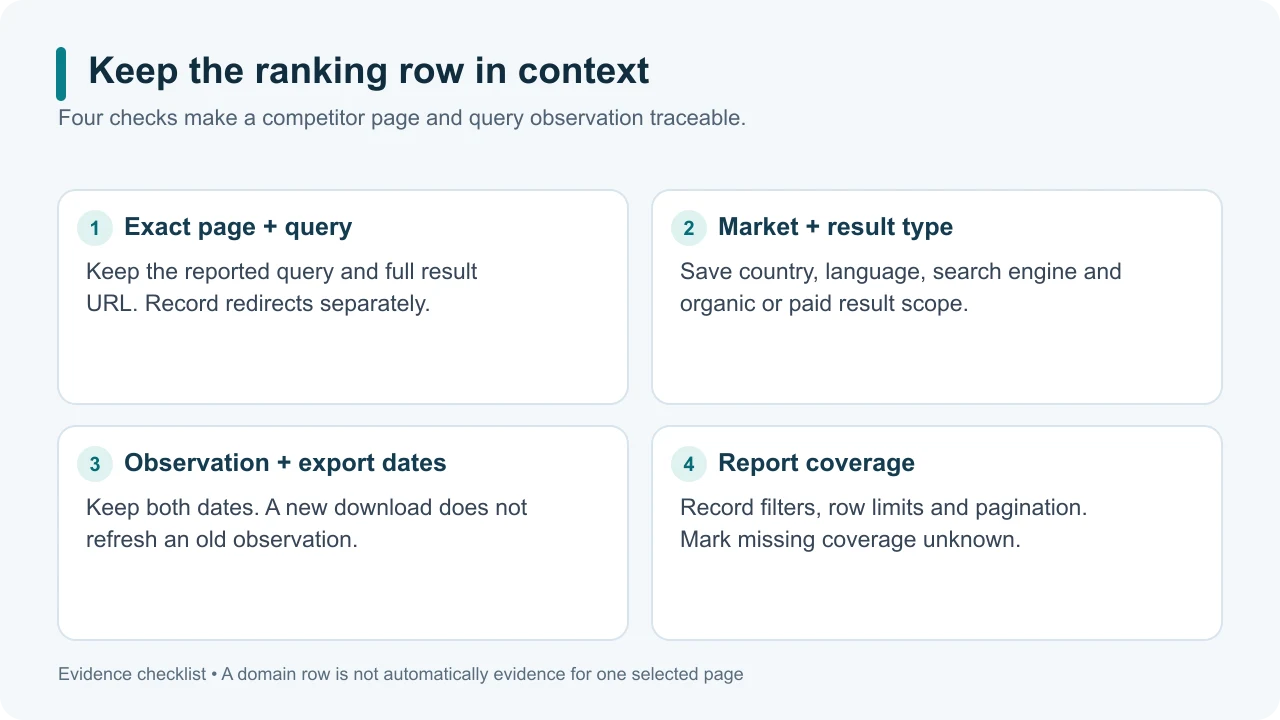
Original illustrative diagram: preserve the context needed to interpret a ranking row.
1. Check the report's scope
Save the provider, report name, export date and settings. Confirm whether the target is an exact URL, subdomain or whole domain. A domain report can include queries served by different pages; that does not establish that your selected page ranks for them.
Also record country, language, search engine, result type, filters, row limit and any pagination. A filtered first page is not the complete dataset. For example, DataForSEO's ranked-keyword documentation distinguishes page/domain targets, locations, languages, result types, filters and returned-item limits. Ranked Keywords documentation.
Begin with the reports you already have. Add further checks only where they can resolve an important uncertainty.
2. Match each row to the exact page
Keep the reported keyword text and full result URL, including its path and meaningful query parameters. If the URL redirects, record the destination separately. Do not silently replace a page URL with its domain or combine different page versions.
Use our page keyword guide when you need to distinguish an exact-page investigation from domain-wide research.
Record both the export date and the ranking observation or update date when available. Downloading an old observation today does not make it current. If the observation date is absent, mark freshness unknown rather than substituting the download date.
3. Describe missing rows precisely
When a candidate query is absent, write “not recorded in this export.” Check whether the page target, market, result type, filters, pagination or dataset date could explain the omission.
Do not convert an empty cell into zero traffic, zero search demand or proof that the competitor does not rank. Equally, words found in the page's headings are candidate topics, not observed ranking rows. Keep inferred topics in a separate column.
4. Choose the next verification action
For a dated row, the next action may be a current query check in the same market. For a domain row pointing to another page, inspect that actual URL. For a missing row, first inspect the report's settings and coverage rather than declaring a lost keyword.
A manual search gives another observation, with its own date and context. Google notes that results vary with time, place, device and recent search history; one check does not establish a permanent rank. Search Console's explanation of result variation.
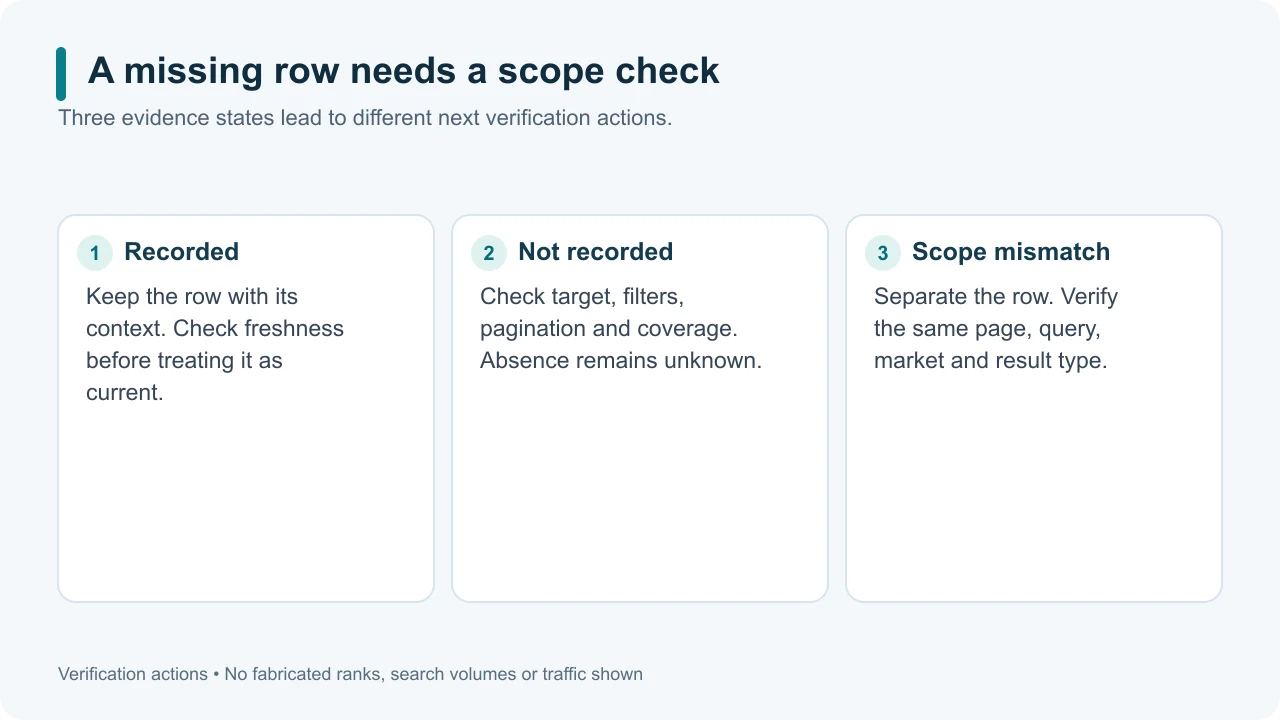
Original illustrative diagram: resolve evidence uncertainty before drawing a ranking conclusion.
5. Save a compact evidence shortlist
Use one row per exact competitor-page/query pair. Add market, source, observation date, export scope, evidence status and next check.
In this hypothetical herb-blog research sheet, no actual rankings are asserted:
Finding | Evidence status | Next verification |
|---|---|---|
Selected page has a row in an older matching-market report | Recorded, current status unknown | Check the query again with matching context |
Query appears only in the page's headings | Inferred topic | Check whether a ranking observation supports it |
Query is absent from a filtered domain export | Not recorded; coverage uncertain | Check filters, target and pagination |
Keep original observations when adding new evidence. When you investigate the query or URL in SearchCub, attach the new context to the same row. Finish with what the evidence supports and the next check, before deciding what content to produce.