- Keyword Research
- Checklist
How to prioritize keywords when search volume is unknown
Editorial responsibility: SearchCub
When search volume is unknown, prioritize reader fit, observed questions, the answer you can prove and the cost of producing it; keep demand uncertainty visible.
Missing volume does not establish that a query is unpopular. It also does not justify claiming a large opportunity. Your goal is to choose a sensible, testable article, with an honest explanation of why it deserves effort.
If available estimates are confusing, begin with the distinction between search volume and keyword difficulty.
Separate observations from guesses
Create an evidence column and a judgment column. “Three readers asked about apartment plant lighting” is an observation if you have the messages. “This could support a useful guide” is a judgment. “Thousands search for it” needs separate evidence.
In this hypothetical example, a small indoor-plant blog has no usable keyword estimates. The editor can still compare three ideas: choosing a spot for a new plant, interpreting leaf discoloration and reviewing a specific grow light. No actual audience messages or product tests are asserted here.
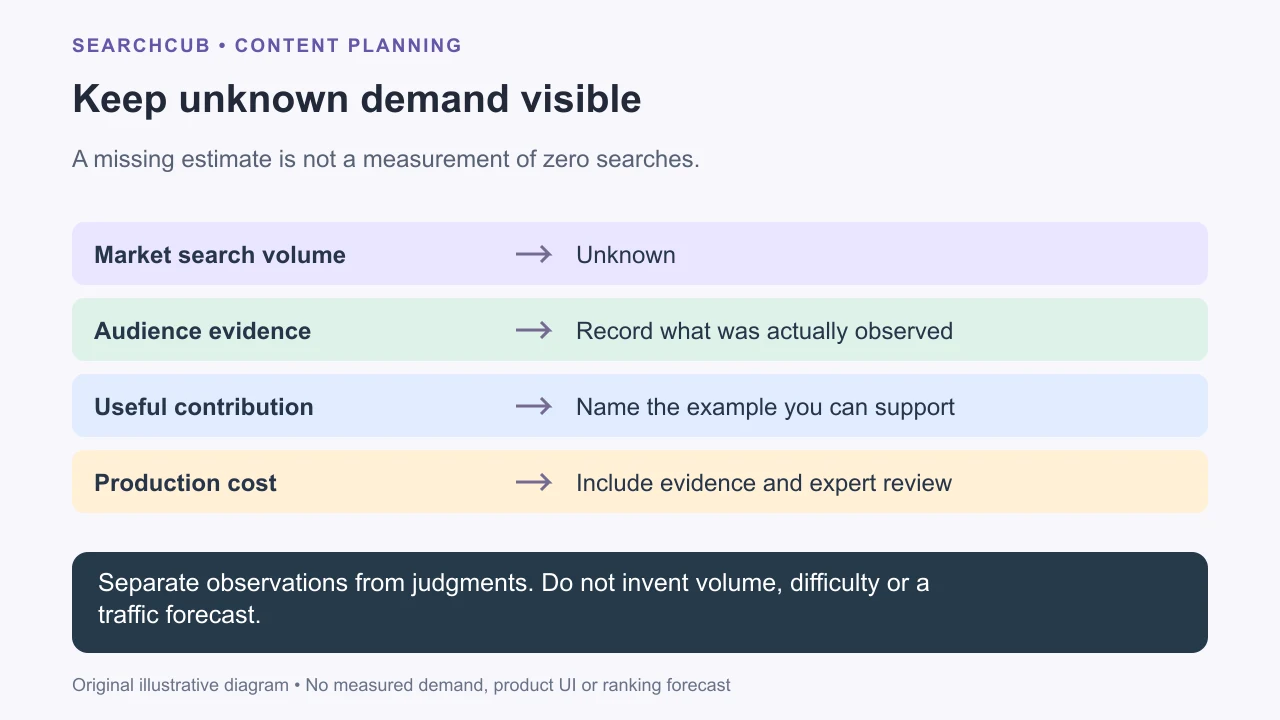
The missing metric is recorded; it is not replaced by a made-up number.
Use a short decision checklist
For each candidate, answer these questions with a sentence rather than a decorative score:
Who needs the answer? Name the intended reader and their immediate task.
What evidence brought this question to us? Use dated audience questions, your site's search data or a documented result sample.
Can we add something useful? Specify the original example, diagram, test or decision rule you can actually provide.
Does an existing page already answer it? Check drafts as well as published content.
What is the cost of a reliable answer? Include specialist review, photographs, product access and maintenance.
What would change our decision? Record the evidence that would cause you to hold, refresh or publish.
An important limitation can outweigh good fit. Plant-disease diagnosis, for example, may require expertise the editor lacks. A clearly bounded placement checklist may be more feasible, provided its practical claims are verified before release.
Use your own search data carefully
If your site has Search Console data, look for relevant queries and pages in the intended country and a stated date range. Google's performance report can help identify queries that show your site and bring clicks. That measures your site's visibility, not the entire market.
A new site with few impressions has limited evidence. Do not rank its ideas solely by small differences in clicks, and do not label an absent query a failure before considering whether the site has relevant coverage.
Choose a bounded experiment
Select one topic with strong audience fit, available evidence and a distinct answer. State what you will deliver and what you will observe afterward. For the hypothetical plant blog, that might be a photographed placement checklist, followed by a review of reader questions and relevant search visibility.
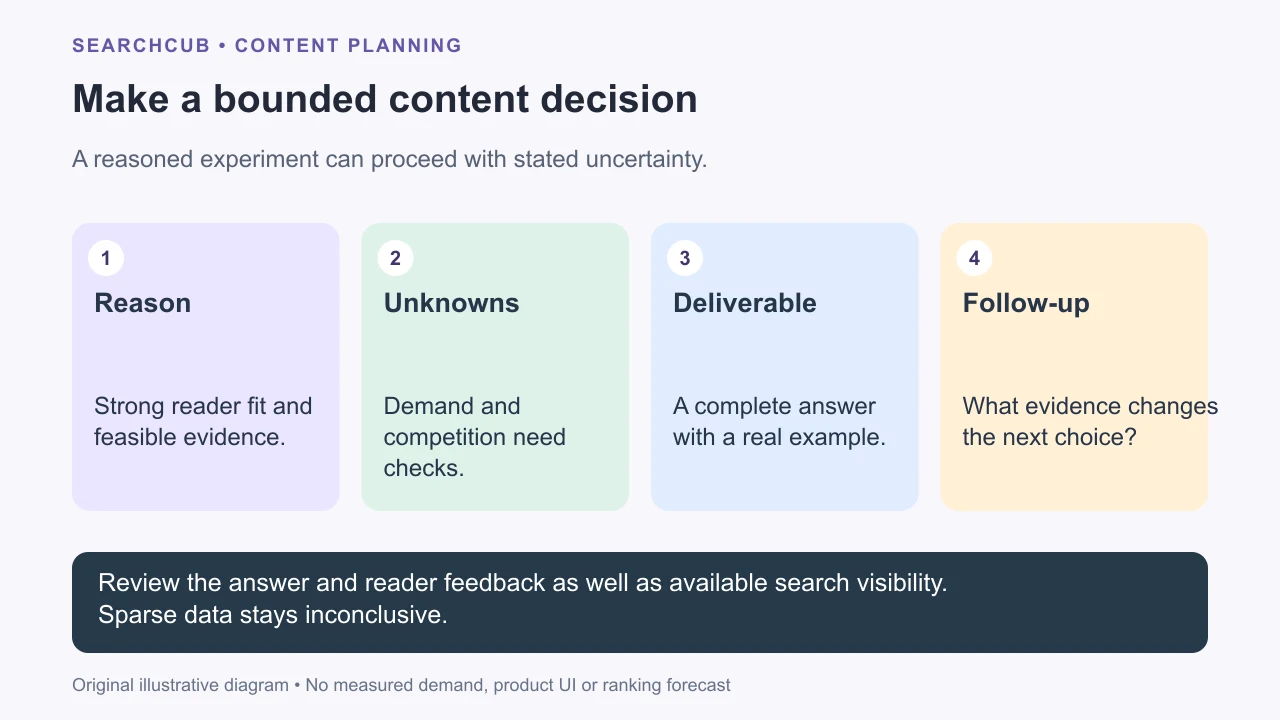
Illustrative decision record: selection remains revisable as evidence improves.
Avoid setting a traffic promise or an arbitrary pass score. A useful early observation might be that readers still ask the same unresolved question. That suggests an answer gap even before search traffic becomes meaningful.
Write the choice into a keyword-led article brief, including “volume unknown,” and check it against common keyword-research mistakes. If you later collect estimates, add their date and market without erasing the original reasoning. Use the same evidence record when planning with SearchCub. Better evidence should improve the plan, not disguise what was unknown when you started.