- Content Planning
- Checklist
How to write a keyword-led article brief that a writer can use
Editorial responsibility: SearchCub
A keyword-led article brief should specify the reader's task, the owning URL, the evidence and the finished outcome—not just a phrase and a word count.
The brief is a small contract between researcher, writer and reviewer. It should let each person understand what to produce and how to judge it without guessing your intent.
Start with six selection fields
Reader: who needs this answer and what do they already know?
Outcome: what can they do after reading?
Primary query and related wording: which question leads the assignment?
Market and evidence: country, language, sources, checked dates and unknown metrics.
Owning URL: refresh an existing page or propose a distinct new destination.
Contribution: the example, evidence or decision aid this article adds.
Keep related phrases as context for the answer. Google notes in its SEO Starter Guide that its language matching can understand query variations. A brief does not need instructions to repeat every variant in every heading.
Use the search-intent guide to name the task, and keep volume and difficulty separate in the evidence fields.
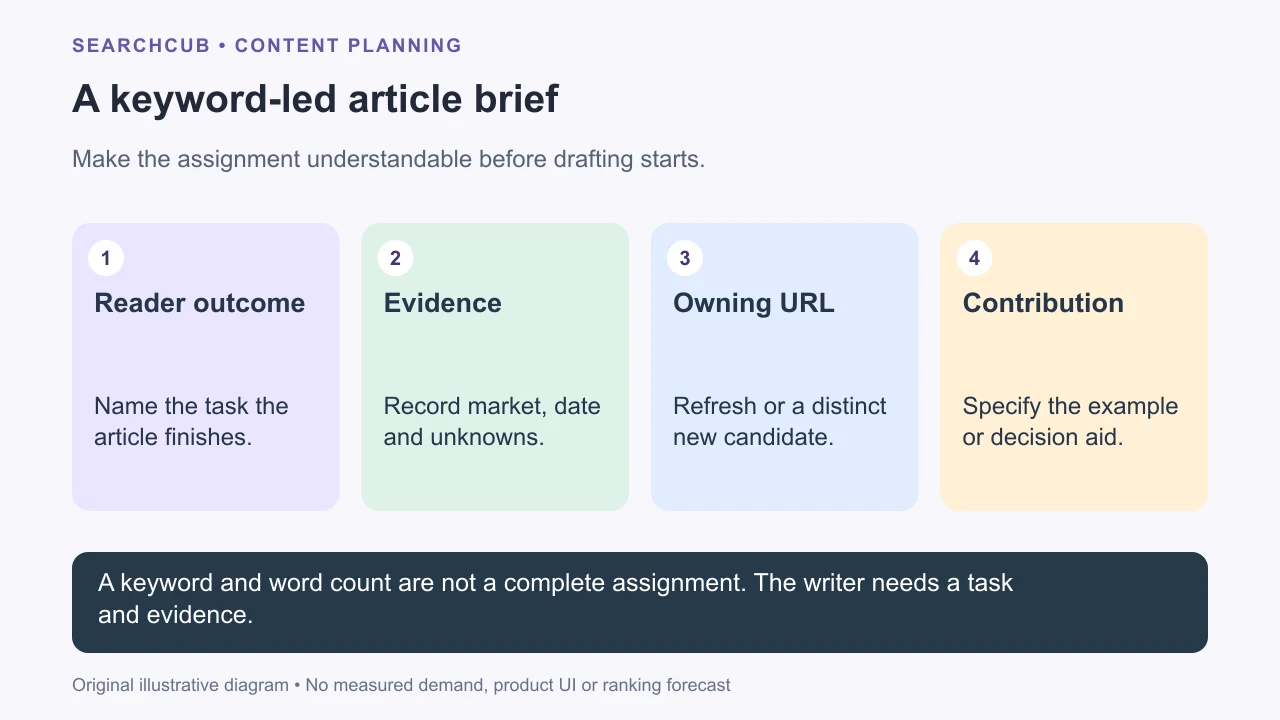
The keyword points to a task; the brief defines the work needed to answer it.
Use a concrete worked example
Here is a hypothetical brief for a page-keyword tutorial. It does not assert that a specific tool feature has been tested:
Field | Example assignment |
|---|---|
Reader and outcome | A small-site owner identifies relevant queries for one existing URL and chooses one improvement |
Primary query | How to find keywords a page ranks for |
Evidence | Own-site query/page export; source and date recorded; market volume unknown |
URL action | Check existing page-keyword coverage before assigning a new destination |
Contribution | A worked query-to-section mapping with explicit limits |
Required output | Complete steps, example interpretation, two explanatory images and a decision checklist |
Specify the evidence the writer must obtain. If the assignment needs a product walkthrough, require a current verified navigation path and authentic results. Do not let an illustrative table become a claimed product observation.
Define the content package
Ask for a direct first sentence, useful headings, a complete example and the important limits. Set a provisional length based on the task, then allow the writer to stop when it is answered.
Include the public topic and format labels. Store keyword estimates, intent decisions and review notes in the private brief rather than turning them into a long list of public tags.
For links, name the prerequisite explanation and the next useful task. Record which existing page should link into a new article. For images, specify the purpose, source, alt text and caption. “Add two images” is weaker than “show the query-to-section map and the final decision checklist.”
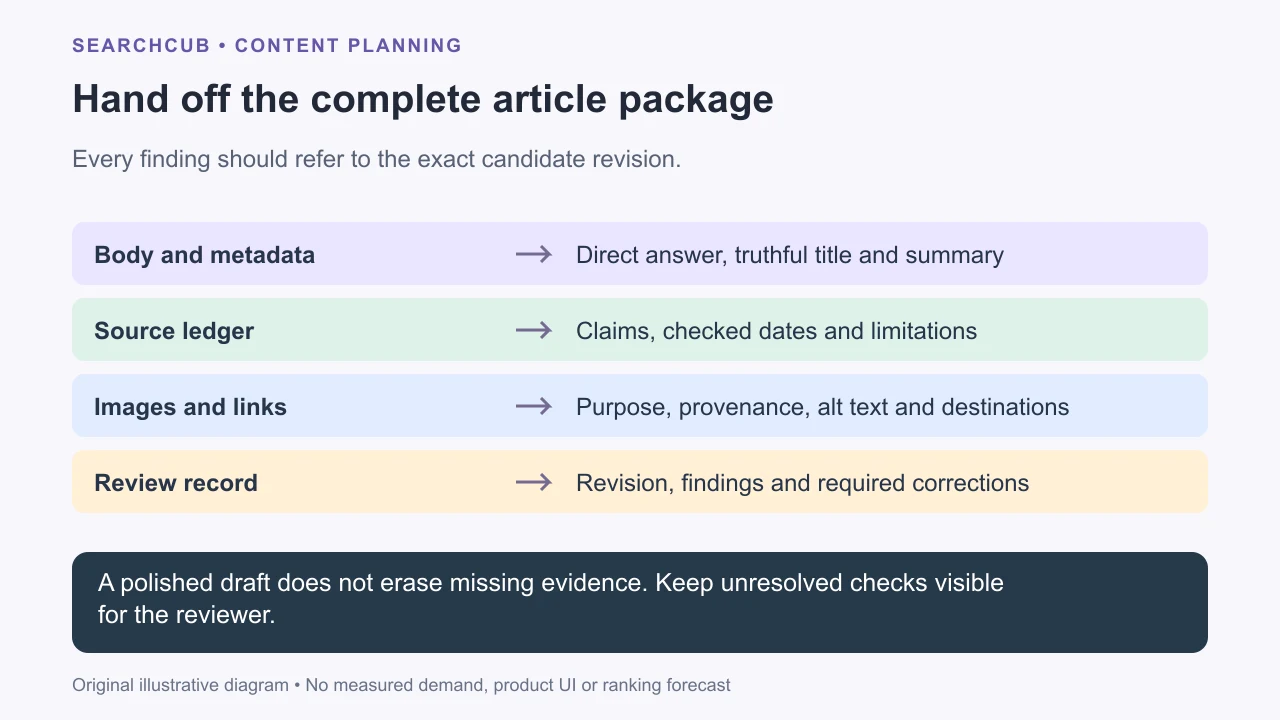
Review the complete package, including metadata and images, rather than the outline alone.
Give the reviewer clear acceptance questions
Ask whether the article completes the task, overlaps current coverage, supports its claims and uses the images and links meaningfully. Require specific findings tied to the reviewed revision.
Keep unknowns visible: missing current inventory, unverified product steps and absent demand data should each have an owner or next check. A polished draft does not erase those gaps.
Before release, use the search-intent review checklist. If SearchCub is part of your research, attach the dated evidence you actually used. The final brief should make the article easier to write and verify, without claiming the keyword alone guarantees traffic.