- Keyword Research
- Tutorial
Types of Keywords in SEO: Which Ones Suit a Blog?
Editorial responsibility: SearchCub
Keywords are usually sorted four ways: by intent (informational, commercial, transactional or navigational), by length, by whether they name a brand, and by whether they ask a question. A blog suits the informational questions and fair comparisons in a list best, and rarely the brand logins or buying searches.
By the end of this post you will have sorted one real list of 100 keyword ideas all four ways and marked each row write, fold in or leave. You will do it in SearchCub's Keyword overview, which shows each keyword's estimated intent. If SEO itself is new to you, start with what is SEO.
The example: 100 ideas around one question
The worked example is the list SearchCub returns for does domain name affect seo, a question people ask when they choose or change a domain name. In Keyword overview, choose Keyword, type the question, choose United States as the Region and click Search. On 7 October 2026 the table headed Keyword set showed 100 loaded, sorted by Monthly searches from high to low. The question itself shows 30 searches a month, difficulty 8 and an Informational tag.
Two numbers on every row matter here. Monthly searches is SearchCub's estimate of the average searches a month in the region you chose. Difficulty estimates how hard it is to rank in the unpaid results, from 0 to 100, and SearchCub calls anything under 30 Easy. Every search figure in this post is an estimate for the United States on that date, not any company's own data.
The phrase you typed is your seed keyword, and the list it returns is rarely tidy. This one runs from company logins to price questions, and its biggest rows are not the ones a blog can use:
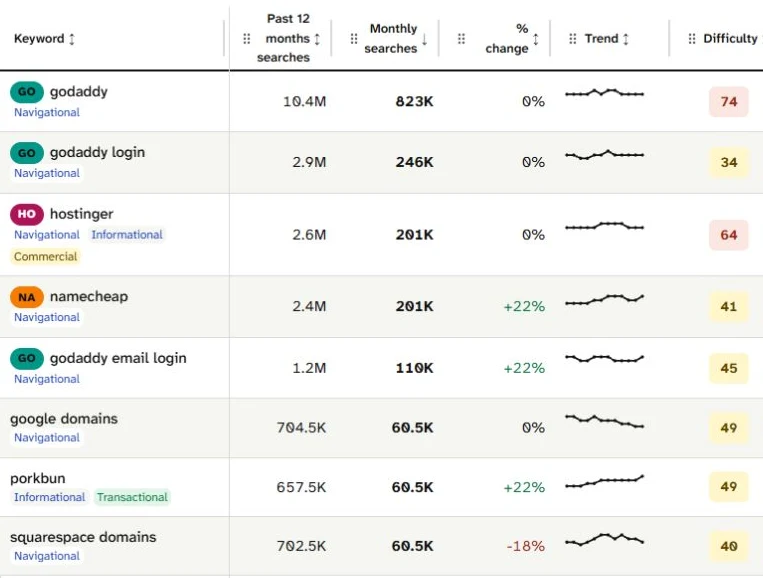
Read the colored tags under each keyword: six of these eight brand rows carry only Navigational, meaning people want that company's own site. hostinger carries three tags and porkbun two, so a tag is a starting clue rather than a verdict.
The table shows 99 rows, not 100, because godaddy domain sits inside the 2 related keywords group under domain name godaddy. The counts below include it.
Intent: what the searcher wants to do
Intent is the most useful of the four sorts, because it tells you what kind of page could help. Click the intent tag in the Keyword analysis panel and SearchCub explains that it "estimates what someone wants to do: learn information, compare options, buy or complete an action, or reach a particular website."
Informational. The searcher wants to learn something. Main tag on: 22 ideas. A row from this list:
how much does a domain name cost per year(320 a month, difficulty 18).Commercial. The searcher wants to compare options before choosing. Main tag on: 25 ideas. A row from this list:
namecheap vs godaddy(590 a month, difficulty 0).Transactional. The searcher wants to buy or act now. Main tag on: 13 ideas. A row from this list:
godaddy buy domain(2,400 a month, difficulty 49).Navigational. The searcher wants to reach one particular site. Main tag on: 40 ideas. A row from this list:
godaddy login(246K a month, difficulty 34).
Each idea has one main tag, shown first, so those four counts add up to 100. Of them, 18 also carry one or two extra tags. The same tooltip allows for this: "A keyword can have more than one intent." An extra tag means people type the same words for different reasons, so read the words to see which reason your page could serve.
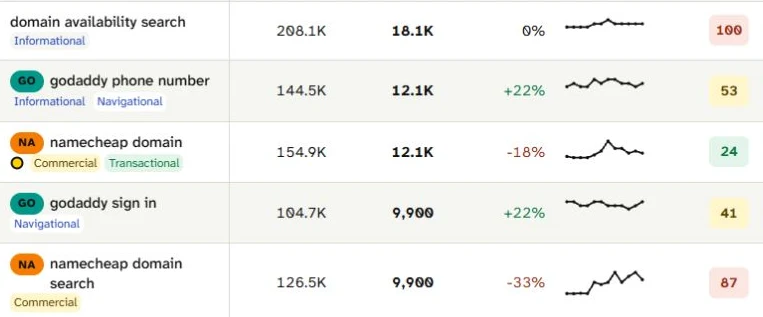
Rows 11 to 15 of the same table, with Monthly searches in bold and Difficulty in the colored box on the right. namecheap domain mixes Commercial and Transactional and, at difficulty 24, is the only Easy row of the five; its yellow dot marks it Easy and rising.
To see one intent at a time, open Filters and sorting, choose a tag under Intent and click Apply filters. The filter keeps a row when that tag is its main one or an extra one, so it catches more than the main-tag counts: 27 of the 100 ideas carry Informational, 29 Commercial, 19 Transactional and 46 Navigational.
Choosing a page type for each intent is a topic of its own: search intent covers it with examples.
Length: short-tail and long-tail keywords
A short-tail keyword, also called a head keyword, is a broad search of a word or two. A long-tail keyword adds detail and usually draws fewer searches. Length is easy to see, but in this list it misleads.
The four one-word rows are godaddy, hostinger, namecheap and porkbun, at 60.5K to 823K searches a month. None of them is vague: each names one company, and three of the four have Navigational as their main tag. Short here means a destination, not a broad topic.
At the other end, three rows have nine words each, from 30 to 2,400 searches a month. how much does a domain name cost per year (320 a month, difficulty 18) states its whole job: one price, for one year. You could write the first sentence of that post today.
Long rows are also where rewordings collect. does domain name affect seo and does domain name impact seo both show 30 a month: one question in two wordings, so one page. SearchCub's note on Monthly searches in Keyword analysis warns that related keywords "may share estimates, so their volumes should not be added together." Long-tail keywords explains when small searches like these are worth a post.
Branded and non-branded keywords
A branded keyword names a company or one of its products; a non-branded keyword describes a need without naming anyone. In this list, 76 of the 100 ideas name one of eight brands: GoDaddy, Namecheap, Hostinger, Porkbun, Squarespace, Google Domains, Cloudflare or Shopify. godaddy alone appears in 36.
Brand and intent overlap heavily here. All 40 ideas with Navigational as their main tag are brand rows: logins, sign-ins, phone numbers and company names. A blog cannot be GoDaddy's login page, so leave those rows to the companies.
The other brand rows are a different matter. Some ask for a comparison or a verdict that an independent writer can give from experience: namecheap vs godaddy (590 a month, difficulty 0), is namecheap legit (590, difficulty 9) and namecheap reviews (390, difficulty 16).
Lines shows how brand-heavy a list is at a glance. It groups loaded ideas that share a word, plus the questions, and three of this list's four lines are companies: godaddy, namecheap and hostinger. To set one company aside, type its name in Exclude words under Filters and sorting and click Apply filters; the box takes one word or phrase at a time.
Once readers start searching for your own name, branded vs non-branded keywords shows how to read those searches apart from the rest.
Question keywords
A question keyword is phrased as a question. In this list they start with how, why, is, where or does, and SearchCub gathers them on the Questions line. Here that line holds nine rows, including does domain name affect seo itself, and all nine carry the Informational tag, as a main or an extra tag.
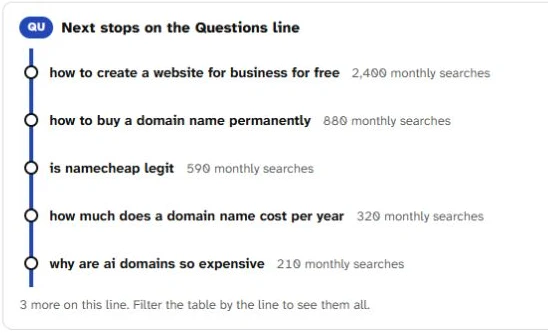
The Next stops on the Questions line card lists the other questions in the set, largest first, and notes 3 more on the line. Each already reads like a post title or a subheading, which is why questions are often the most natural kind of keyword for a blog.
Question rows still need sorting. how to create a website for business for free has the biggest number on the line, 2,400 a month, but difficulty 100. is namecheap legit (590, difficulty 9) and why are ai domains so expensive (210, difficulty 0) are smaller and far easier. To filter the table to these rows, open Lines and choose Questions.
Which types of keywords suit a blog
Put the four sorts together and each row lands in one of three piles: write a post, fold it into another post, or leave it. Picture a blogger who writes for people setting up their first website:
A company's own site. From this list: tag, monthly searches, difficulty:
godaddy login: Navigational, 246K, 34. Pile: Leave. Only the company can answer it.To buy now. From this list: tag, monthly searches, difficulty:
godaddy buy domain: Transactional, 2,400, 49;buy domain and email: Transactional, 1,600, 33. Pile: Leave, unless you sell it.A tool. From this list: tag, monthly searches, difficulty:
domain availability search: Informational, 18.1K, 100;domain expiry checker: Informational, 1,300, 13. Pile: Leave, unless you offer that tool.A comparison or verdict on brands. From this list: tag, monthly searches, difficulty:
namecheap vs godaddy: Commercial, 590, 0;namecheap reviews: Informational, 390, 16. Pile: Write, if you have used them and can compare fairly.A general question. From this list: tag, monthly searches, difficulty:
how much does a domain name cost per year: Informational, 320, 18;why are ai domains so expensive: Informational, 210, 0. Pile: Write. This is the closest fit for a blog post.The same question reworded. From this list: tag, monthly searches, difficulty:
does domain name impact seo: Informational, 30, 15. Pile: Fold it into the post fordoes domain name affect seo.
For that blogger the plan is short: one post for how much does a domain name cost per year, with a section for why are ai domains so expensive, and one comparison for namecheap vs godaddy, with is namecheap legit as a section, but only if the writer has used both. The seed question and its rewording share a single post, the way does your domain name affect SEO answers it on this blog. The 40 ideas with Navigational as their main tag stay with the companies.
The tags did not make these calls alone. domain availability search is tagged Informational, yet its words ask for a search box, and its difficulty of 100 is the top of the scale. godaddy phone number (12.1K a month) shows Informational first, yet it asks for one company's contact details and carries Navigational too. Read the words before you trust the tag.
Check the results page before you write
A tag estimates what people want; the results page shows what Google returned for them. Click a row to open its Keyword analysis, then scroll to its SERP overview, SearchCub's summary of the search results page. For does domain name affect seo, checked for United States desktop results on 7 October 2026, it showed an AI overview, a People also ask box and nine organic results. Six had explainer titles such as "Domain Names and SEO: Exploring the Connection"; the other three were a Reddit thread, a LinkedIn post and a Quora question.
A page one of explainers and discussions is the kind a blog post competes on. Check every row in your write pile the same way. If page one for a row is all registrar and shop pages, move it to leave, whatever its tag says.
What the tags cannot tell you
The 100 rows are a loaded sample, not every search on the topic: the table ends with "More matching keywords are available." and a Load more keywords button. And no tag knows what you can write from experience, which is what decides the comparison rows.
Your next step
Open Keyword overview, type the main question your blog answers, choose your readers' Region and click Search. Open Lines and choose Questions to read the questions first. Then choose All lines again and use Filters and sorting with Intent set to Informational, then Commercial, marking each row write, fold in or leave.
Start with the Easy rows in your write pile. To decide which post to write first, see keyword research for bloggers, and to pick a better starting phrase, see seed keywords.