- Informational
Long-Tail Keywords: Are Small Search Volumes Worth Targeting?
Editorial responsibility: SearchCub
A low-volume keyword is worth targeting when it reaches the right reader, needs an answer you can provide, and justifies the effort to create or update a page. A smaller audience with a clear problem can be more useful to your site than a large audience looking for something you do not offer.
Start by asking what the reader would gain from your page. Then use search volume, difficulty and the actual results to decide how much work the topic deserves.
What makes a keyword long-tail?
Long-tail keywords sit in the lower-demand part of the search market. They are often specific, but word count does not define them: a long phrase can be popular, and a short phrase can attract few searches. Ahrefs' explanation makes this distinction and notes that there is no universal volume cutoff.
For planning, “how to stop coffee grounds spilling from a hand grinder” describes a narrower task than “coffee grinder.” Whether it has low search volume needs a real query. Specific wording alone does not establish demand or difficulty.
1. Find a problem your audience already cares about
Start with questions from customers, reader comments, support conversations or your own experience. Look for a constraint that changes the answer: limited space, a particular material, a budget or a repeated failure.
In SearchCub, choose Keyword, enter the topic, choose a country, and click Search. Review the returned phrases for those specific needs. Open Filters and sorting, enter a relevant term in Include words, then click Apply filters to narrow the loaded results.
Keep a short list. The aim is to find a useful topic you can finish, rather than collect every variation of the phrase.
2. Read volume and difficulty together
Monthly searches estimates average monthly demand in the selected region. Difficulty estimates the organic ranking challenge on a 0–100 scale. Choose a country when comparing difficulty; SearchCub does not supply an organic difficulty score for Worldwide research.
Click a promising keyword to see its analysis and monthly history. A seasonal peak may matter more than the average for a seasonal business. Google's historical keyword metrics explain how location, date range and seasonality affect interpretation.
Small volume is a reason to consider the effort carefully. It is not a reason to skip the result-page review. A low-volume phrase can still have strong competition, and a missing estimate leaves demand unresolved.
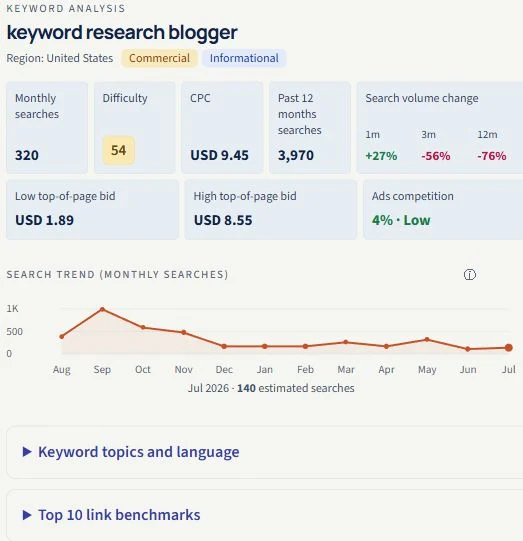
A U.S. example captured on 14 September 2026: 320 estimated monthly searches can still justify a closer look when the audience fits. The score alone does not decide whether to publish.
3. Decide whether it needs its own page
Open the keyword's SERP overview and inspect relevant result pages. Compare the reader's task with any page you already have.
What you find | Sensible next action |
|---|---|
A specific problem needs its own steps or demonstration | Consider a focused new article. |
The phrase asks a small question inside an existing topic | Add a useful section to that page. |
Several phrases need the same answer | Cover them together in one page. |
You lack the experience or evidence to answer well | Research further or choose another topic. |
For example, a grinder cleaning guide could include a section about removing trapped grounds. A guide to diagnosing a motor that will not start needs different knowledge and may deserve a separate page. These are editorial examples; inspect the actual queries before settling the structure.
4. Match the effort to the opportunity
Use these three questions to set your priority:
Audience: Would this reader value the rest of your site or offering?
Contribution: Can you provide something concrete, such as a tested fix, photographs or a useful comparison?
Effort: Can you answer completely without a disproportionate research or maintenance burden?
Do not multiply the keyword's volume by an assumed conversion rate to claim a likely return. Start with the page you can justify, then measure what happens.
5. Review the page after publication
In Google Search Console, inspect the page's impressions, clicks and queries over a consistent period. Its Performance report shows these measures and supports page and query views. Check relevant actions on your own site separately.
Keep, improve or expand the page based on the readers it reaches and the questions it answers. For a practical way to choose and record the next topic, follow keyword research for bloggers.