- Keyword Research
- Tutorial
How to Do Keyword Research for Affiliate Marketing
Editorial responsibility: SearchCub
Choose an affiliate keyword by matching a buyer's decision to the search results and the claims you can support. You will finish with a topic, a record of what its review sources actually establish, and a decision about the work needed before writing. Start in SearchCub's Keyword ideas, then inspect the pages behind the search results.
The worked example starts with cold brew coffee and follows top-rated cold brew coffee maker. It uses United States English search data checked on October 6, 2026, plus the publishers' own descriptions of their methods. The resulting audit will guide your choice of article and the claims it can make.
Start with the buying decision
Write the decision a reader needs to make before choosing a phrase. For this topic, that might be choosing a maker for a particular routine: preparing coffee quickly, making a larger batch, or fitting a container in the refrigerator. These are questions to investigate, not findings about any product.
Open Keyword ideas, type cold brew coffee in Keyword, select United States under Region, and click Search. Scan the returned phrases for decisions that involve products. A recipe query leads to a different article from a category recommendation, even when both use the same seed.
In the cold-brew results from Keyword ideas, open top-rated cold brew coffee maker. Clicking a keyword opens Keyword analysis. The selected phrase has Monthly searches of 3,600 and Difficulty of 4, with Commercial intent.
Monthly searches estimates how often the phrase is searched in the selected region; difficulty estimates competition in the search results. Use them to select a phrase worth inspecting. These estimates are not traffic or affiliate income forecasts, and a low difficulty score is not a ranking promise.
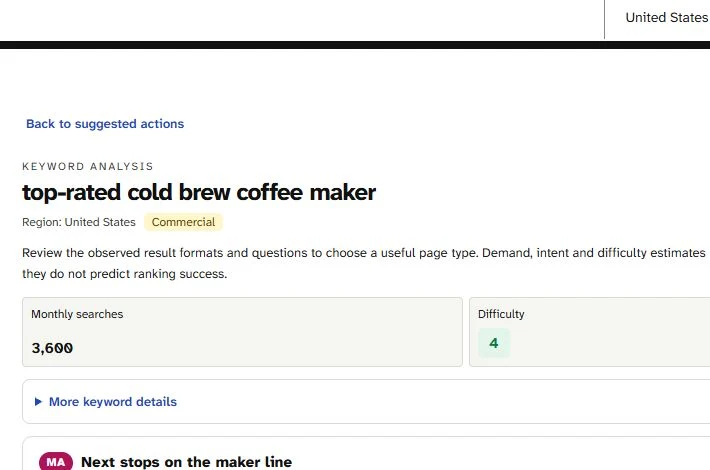
The commercial label makes this a candidate for buying advice; inspect the results before deciding what kind of recommendation you can contribute.
Keep this phrase on your shortlist. Your next question is whether the results and your available material support a useful article, not whether the number looks attractive.
Check what the results help people do
Open SERP overview in the selected keyword's analysis; you can also enter the phrase in Keyword overview. SERP means search engine results page. Look at both the result types and the promises made by individual pages.
The saved desktop results mix Reddit discussions, a Bed Bath & Beyond collection, Lemon8, The Week's curated list, Best Buy customer reviews, GQ's personal recommendation, another roundup, and an Amazon product. That is a mix of shopping, recommendations, and experiences. It is not a uniform set of controlled product comparisons.
Open the publisher pages, rather than inferring their methods from a title. GQ's 2019 OXO article describes Daniel Varghese's personal use of an OXO Good Grips maker. The Week's 2018 list explicitly draws on other publications' recommendations. The inspected GQ body supplies no shared category test protocol; The Week's body supplies no account of its own product tests.
Record those as different kinds of sources: a personal-use recommendation and a curated list. Their presence in this search gives you pages to investigate; it does not explain their rankings or establish that either tested the whole category.
Now state the promise you are considering: “help a reader choose a cold-brew maker for a specific routine.” A page that simply collects favorable opinions gives you less basis for your own comparative verdict than a set of observations tied to that routine. For more help distinguishing the reader's task from a keyword's label, use the search intent guide.
Keep each source's claims attached to its methods
Search the related product phrase cold brew coffee oxo in Keyword overview and open its SERP overview. The inspected product-query analysis includes Serious Eats' OXO Rapid Brewer review and WIRED's review as organic results. A Serious Eats category roundup also appears in Perspectives.
These are supplementary evaluations from a separate query. Keep that origin in your notes instead of treating them as results for top-rated cold brew coffee maker. A product query can uncover useful review evidence even when its overall intent label is Transactional.
For each opened page, record the exact model, who observed it, the conditions, the measurement basis, and the scope of the claim. The following notes describe published accounts; they are not our tests or taste findings.
Source | What the inspected account describes | Keep this boundary attached |
|---|---|---|
Rochelle Bilow uses 40 g coffee and 160 ml water, varying grind, temperature, and tamping. Her cold preparation steeps for five minutes and is served with milk and ice. | The account concerns this device and these preparations; a fully matched AeroPress comparison protocol is not supplied. | |
Madeline Muzzi reports ten makers and two batches each, including a standardized 16-hour room-temperature brew, equal-water dilution, and trials following maker instructions. | The Rapid Brewer section links a separate review. Keep that addition separate from the standardized trial unless the source establishes its inclusion. | |
Matthew Korfhage describes 40 g of finely ground, tamped medium-roast coffee, a five-minute steep, and pumping the concentrate. An extraction explanation is separately attributed to OXO. | A reviewer's use account and a manufacturer's explanation are different evidence; the inspected comparison lacks complete matched settings. |
A bare note saying “both sites tested OXO” loses the distinctions you need. Good Grips, Compact, and Rapid are model names with different scopes in these pages. Keep the complete model name beside every observation, including the sources you opened from the broad query.
Check whether the observations can be combined
Before making a comparison table, ask whether its rows describe the same task under compatible conditions. Sharing a brand or the word “cold brew” is insufficient. A comparison needs a clear basis for treating the observations as comparable.
For the real sources above, separate the overnight category protocol, the maker-instruction trials, and the individual Rapid reviews. Assigning the roundup's 16-hour protocol to every listed product would manufacture a shared experiment. Keep the Rapid addition's method attached to its own review.
Next, check the outcome you want to compare. “Brews faster” requires a defined start and finish: steeping alone, or preparation through a drink ready to serve? A concentrate and a diluted drink represent different endpoints. Likewise, a preference reported after adding milk and ice answers a different question from an evaluation of equally diluted drinks.
Two accounts using the same coffee weight and steeping time still leave other conditions to check. Grind, roast, water amount, dilution, and the alternative brewer's settings affect what comparison you are making. Leave the relative result blank when those conditions are missing, rather than averaging unlike opinions into a score.
Finally, separate observation from explanation. An attributed manufacturer statement can explain what the manufacturer says about a design. Calling that statement a measured extraction advantage would change the kind of evidence you have. Decide whether your proposed sentence reports an explanation or makes a causal claim that needs investigation.
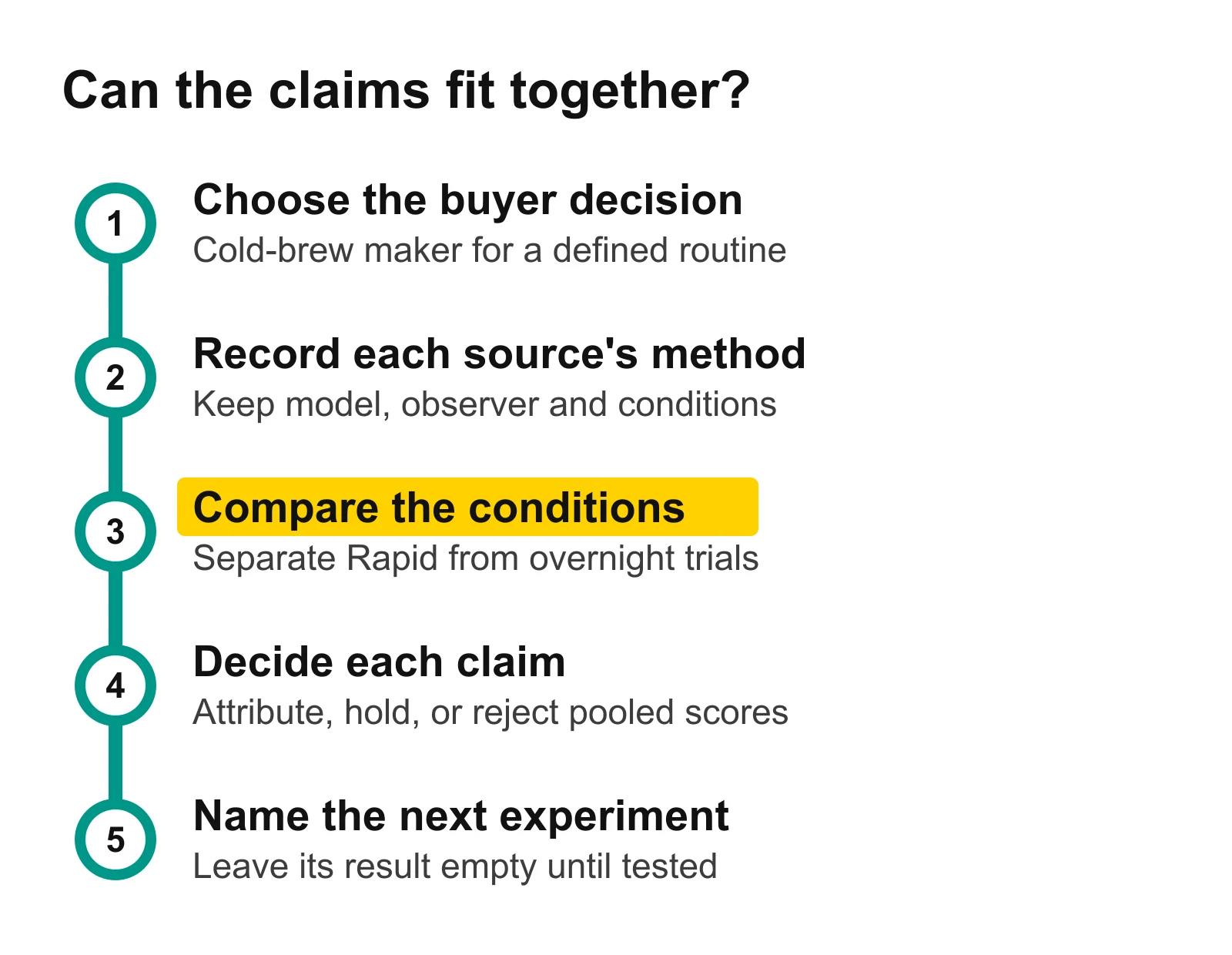
Compare conditions before combining findings; incompatible accounts stay separate, and the missing comparison becomes a precise next task.
This is a check you perform in the opened pages. SearchCub supplies keyword and result information; it does not assess a review's testing methods or certify a recommendation.
Decide which claims you can write now
For this exercise, start with the public-source notes above and leave your own product access and original observations unfilled. That keeps the decision explicit: you have inspected real pages, but you have supplied no new brewer experiment.
Use claim-sized decisions instead of marking the entire topic “researched.” An attributed summary, a firsthand review, and an independent category winner require different material. The same keyword shortlist can therefore lead to different writing decisions.
Planned claim or output | Decision with these source notes | Next evidence to obtain |
|---|---|---|
Explain which recommendations and experiences the search results contain | Write a dated, attributed account of the inspected pages | Preserve each page's source, model, and stated method |
Say “I tested the OXO Rapid Brewer” | Hold the firsthand claim | Your own use record and original process photos for that exact model |
Declare a category winner for a particular routine | Hold the independent verdict | Relevant alternatives evaluated against the same buyer decision and stated criteria |
Pool all sources into a performance score | Reject the pooled score | Compatible observations, with a justified method for any combination |
Say one brewer is faster than another | Hold the relative claim | Both devices measured against the same defined endpoint, with repeated observations |
Present the brand's extraction explanation | Attribute the explanation; leave the causal verdict open | Evidence that directly evaluates the proposed effect |
The demonstrated choice for top-rated cold brew coffee maker is to hold a new independent comparative recommendation while defining the missing comparison. Public accounts can remain attributed research notes. A label such as “tested by us,” a category winner, or a numerical score must describe work you actually completed.
Google's review guidance recommends evidence of your own experience, useful measurements, meaningful alternatives, and a supported basis for best-for recommendations. Use that guidance to improve the substance of your proposed page. It is not a promise that any particular format will rank.
Choose a narrow experiment tied to the claim, rather than a vague instruction to “test some makers.” For a speed comparison, define the drink and serving size, which preparation and cleanup tasks count, and the start and finish of timing. Record each device's instructed method separately from any common protocol, and name the alternatives the buyer would actually consider.
Keep the planned result empty until the work is done. If product access is unavailable, hold the comparative promise or consider an explicitly sourced explanation of a different task. Check that task's query and results before treating it as another article opportunity.
Save the decision and take the next step
Download the filled affiliate evidence audit. Its rows retain the query, proposed claim, source context, conditions, decision, and missing original work. Replace the cold-brew rows with your own inspected sources as you repeat the process.
Keep the source notes separate from proposed experiments. This prevents a plan from turning into an apparent result when you later write. For older recommendations such as the GQ and The Week pages, check current exact-model documents before making current specification, availability, or price claims.
After that decision, use the keyword-led article brief to turn the supported promise into reader questions and required material. Use keyword research for bloggers to place the topic among the other pages your site needs.
Your next action is to open Keyword ideas, enter a product-category seed you know, and select Region. Open a buying-related phrase, inspect its SERP overview, and fill the claim decisions before choosing what to write.