- Keyword Research
- Checklist
Page keywords versus ranking queries: what each can tell you
Editorial responsibility: SearchCub
Page phrases tell you what a document says; ranking queries tell you which searches have shown that page in a particular dataset. Use both, but do not substitute one for the other.
This distinction matters when a keyword extractor returns a persuasive-looking list. It has found text patterns, not necessarily search demand, rankings or traffic.
Three lists with three jobs
List | What it describes | Useful decision |
|---|---|---|
On-page phrases | Words in titles, headings and body copy | Does the page explain its subject clearly? |
Observed ranking queries | Searches associated with the page in a dated report | What questions are already finding this URL? |
Candidate target queries | Searches you may want the page to serve | Does this task belong here, and can we answer it well? |
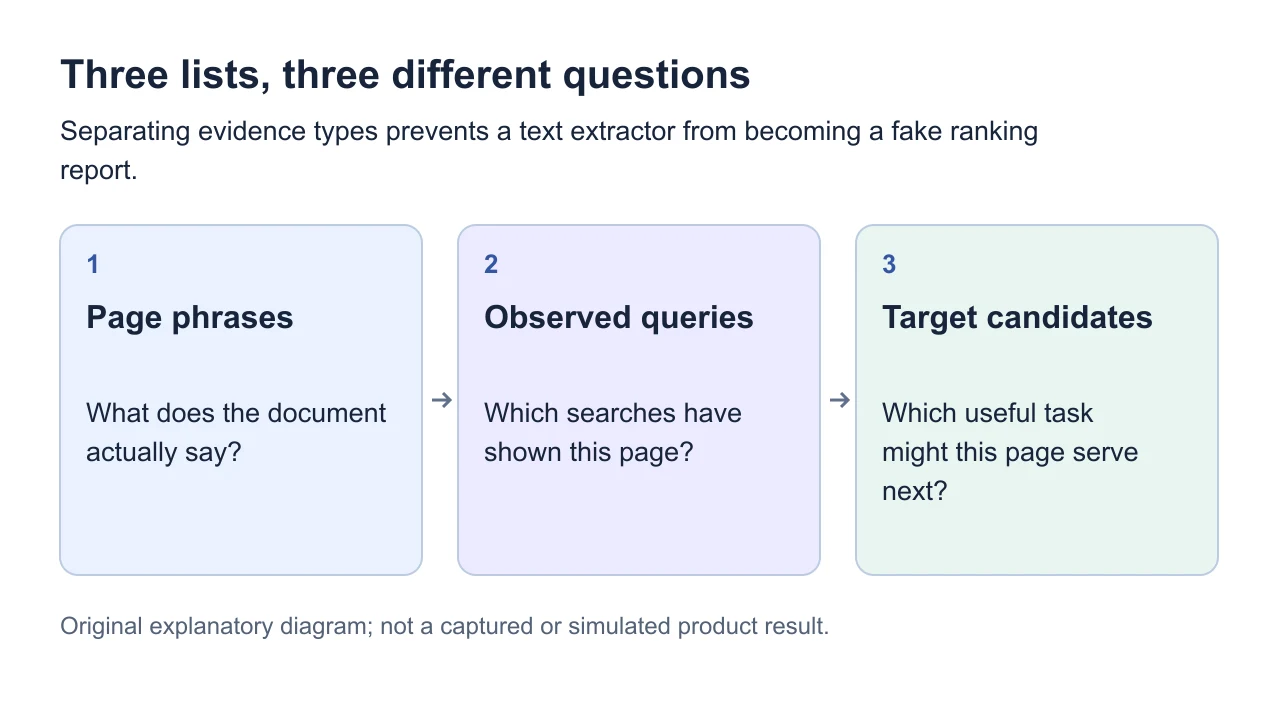
An original explanatory diagram; these lists are not a captured product report.
Google can understand query variations even when the exact wording does not appear in the page. Its SEO Starter Guide recommends anticipating reader language without forcing every variant into the text.
A practical example
Imagine a fictional guide titled “Fix a leaking kitchen tap.” It repeats “washer replacement” and explains several repair steps. Those are useful on-page phrases.
Its hypothetical query export might instead contain questions about a dripping faucet and a leak around the handle. These phrases use different language but may describe tasks the guide can answer. We have not supplied real rankings, volumes or traffic for this example.
“Emergency plumber near me” would be a different candidate. A repair guide does not become a local booking page merely by repeating that term. The reader's desired result determines whether it belongs.
Check a tool's evidence before acting
For each phrase list, ask:
Was it extracted from text, observed in search performance, or suggested as a topic?
Does it describe this exact URL, a domain, or a general keyword?
Which date, country and device does it cover?
Are the numbers observed metrics, provider estimates or unavailable?
What decision would change if the phrase were removed?
For your own site, a page-filtered Search Console report supplies observed query evidence. Its query table has privacy and coverage limits, so absent rows remain uncertain. Google documents those limitations.
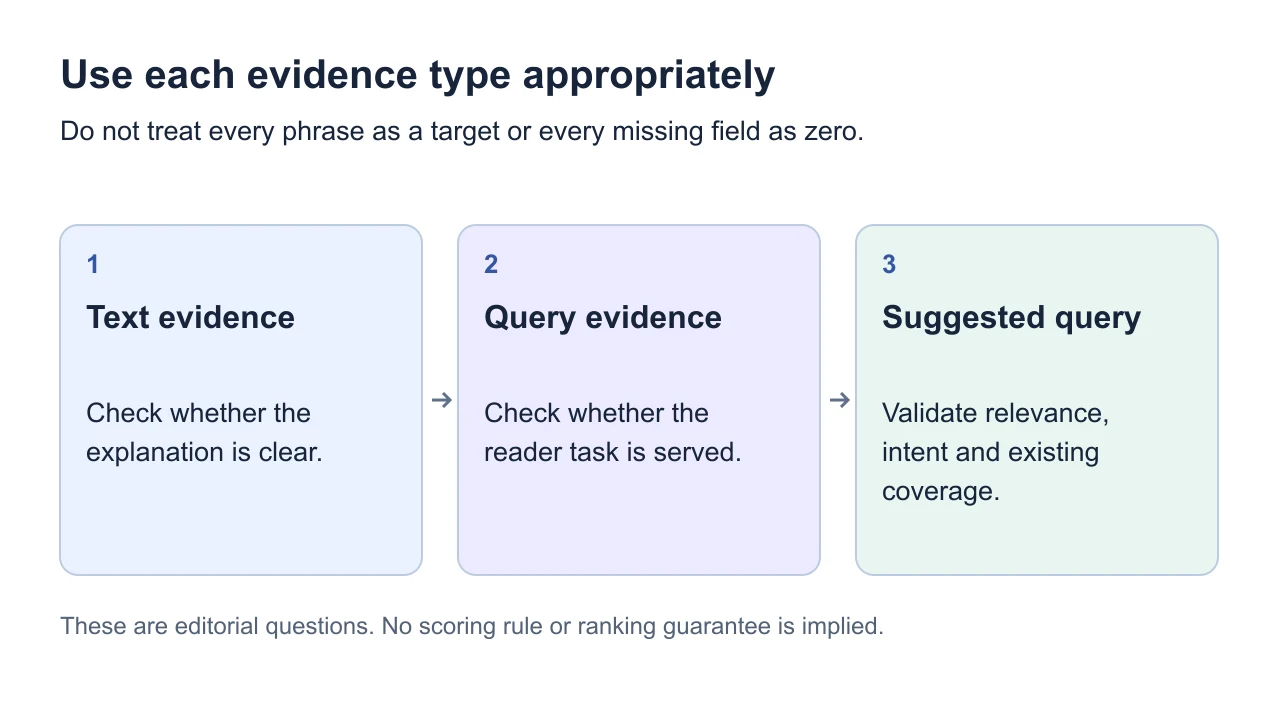
Choose an action based on the evidence type, rather than treating every phrase as a ranking target.
Use the distinction in your next refresh
Save one small worksheet with separate columns for phrase, evidence type, reader task and action. Keep synonyms together when they serve the same task. Rewrite unclear passages for people, rather than counting repetitions to satisfy a supposed keyword-density rule.
Use the page keyword workflow to collect ranking evidence, then check search intent before changing the page's promise. If the desired task already has an appropriate page, improve that intent owner instead of creating another article for a wording variant.
Visit SearchCub for your next research step, keeping extracted phrases, observed results and proposed targets clearly labelled in your notes.