- Keyword Research
- Tutorial
Keyword Research for Tech Tutorial Blogs: Name the Version
Editorial responsibility: SearchCub
Start with the bare task, not a version: one search for it shows which releases, products and machines people name, and the most-searched release you can run yourself becomes your first tutorial. Every other setup gets its own page later, and each page says which release it was tested on and when.
Every figure here comes from a single Keyword ideas search for install docker ubuntu, with results for the United States, run on 8 October 2026. The aim is to choose which installation tutorials to write, setup by setup. It contains no installation steps and makes no claim that any command works.
Search the task without a version
Leave the version number out of the seed: search the job the tutorial does. Choose Keyword, set Region to where your readers search, then click Search. The seed row, marked Seed keyword, averaged 9,900 searches a month, with a difficulty of 24. Difficulty runs from 0 to 100, and a higher score means SearchCub rates the search harder to rank for organically.
Around the seed, the Keyword set lists what people add to the bare task: a release number, a Docker product, a machine or environment, or another operating system. Of the 100 rows SearchCub loaded, leaving more unloaded and uncounted, 14 name an Ubuntu release. The largest is install docker ubuntu 24.04, at 480 searches a month and difficulty 17.
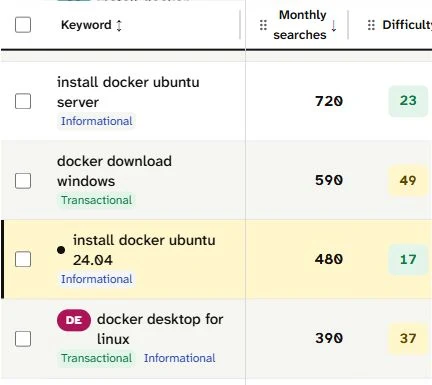
The release row sits among setups: install docker ubuntu server (720 a month) above it and docker desktop for linux (390) below. Its difficulty of 17 is lower than the server row's 23 and the desktop row's 37.
Scroll further and the older release turns up with fewer searches and a higher score.
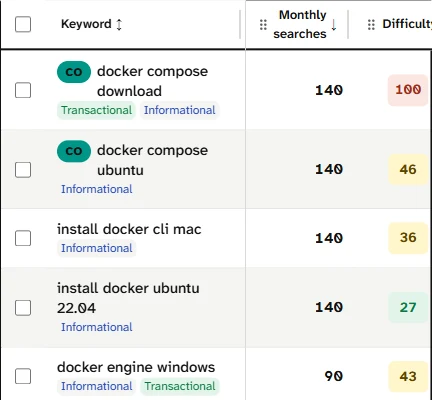
install docker ubuntu 22.04 averages 140 searches a month at difficulty 27, under a third of the 24.04 row's searches. The CO badges mark rows on the compose line, where SearchCub groups most of this set's Docker Compose searches.
What people add to the bare task
Each row adds something to the bare task, and each kind of addition changes the plan differently:
An Ubuntu release. Rows (monthly searches, difficulty):
install docker ubuntu 24.04(480, 17),ubuntu 24.04 install docker(170, 15),install docker ubuntu 22.04(140, 27),how to install docker on ubuntu 22.04(70, 15),install docker ubuntu 20.04(20, 21). What it means for your plan: One tutorial per release you can run.ubuntu 24.04 install dockeris the same request reversed: cover both in the 24.04 tutorial and size it by the 480 row.Docker Engine or Docker Desktop. Rows (monthly searches, difficulty):
docker desktop ubuntu(390, 37),install docker engine ubuntu(260, 31),how to install docker desktop on ubuntu(90, 22). What it means for your plan: Name the product in the title. Desktop has enough rows for a page of its own.A machine or environment. Rows (monthly searches, difficulty):
install docker ubuntu server(720, 23),how to install docker on ubuntu server(170, 24),install docker on wsl ubuntu(30, 18),install docker ubuntu wsl(20, 8). What it means for your plan: A server tutorial is a page in its own right; the WSL rows are small.Another system. Rows (monthly searches, difficulty):
install docker debian(2,900, 37),install docker windows(2,900, 66),install docker linux(2,400, 43),docker desktop linux mint(40, 0). What it means for your plan: Treat each as a separate starting search.Something around the install. Rows (monthly searches, difficulty):
install docker and docker-compose ubuntu(880, 19),uninstall docker ubuntu(390, 10),zsh: command not found: docker(320, 0),docker compose is not a docker command(210, 0). What it means for your plan: Companion posts or sections, built from what happened during your own runs.
At 2,900 a month, install docker debian outweighs any Ubuntu release row, so it earns its own research rather than a paragraph in the Ubuntu post.
Three rows read like error messages pasted into the search box, unable to locate package docker-compose-plugin (170) among them, all at difficulty 0.
Reversed wording is a different matter from a different release: ubuntu 24.04 install docker wants exactly what install docker ubuntu 24.04 wants. How many keywords one page should target covers when wordings share a page and when a task needs its own. The release rows themselves are small next to the seed, the specific kind of search that long-tail keywords explains.
How the release rows changed in a year
Each row's history is a click away: click its keyword, and in the Keyword analysis that opens, expand More keyword details, where the Search trend (monthly searches) chart plots the past 12 months. The list below gives the first and last month of each chart, with the 12-month change SearchCub reports for that row:
install docker ubuntu 24.04. September 2025: 720. August 2026: 260. 12-month change: -64%.install docker ubuntu 22.04. September 2025: 210. August 2026: 50. 12-month change: -76%.install docker ubuntu 20.04. September 2025: 50. August 2026: 10. 12-month change: -80%.install docker ubuntu, no release. September 2025: 12,100. August 2026: 6,600. 12-month change: -45%.install docker ubuntu server. September 2025: 590. August 2026: 590. 12-month change: 0%.how to install docker on ubuntu server. September 2025: 70. August 2026: 170. 12-month change: +89%.
What the numbers show, and no more:
All three release rows fell, and the older the release in the search, the bigger the drop.
Each fell further than the seed, which names no release.
The 24.04 row held between 590 and 720 a month from September 2025 to April 2026, then dropped from May onward, to 260 by August.
The two server rows, which name no release either, held level or grew.
All 14 release rows in the set report a fall over the 12 months.
A release-specific tutorial can lose much of its search demand within a year. One year of data says nothing about the next, but it does settle a choice between releases: in this set 24.04 beats 22.04 on searches (480 against 140), on difficulty (17 against 27) and on a smaller fall (-64% against -76%). If you already have a 22.04 tutorial, keep it accurate and dated, link it to the new 24.04 page, and use the guide to updating an existing post to decide when it needs work.
What the 24.04 row shows when you open it
The 24.04 row's Keyword analysis opens when you select it in the table.
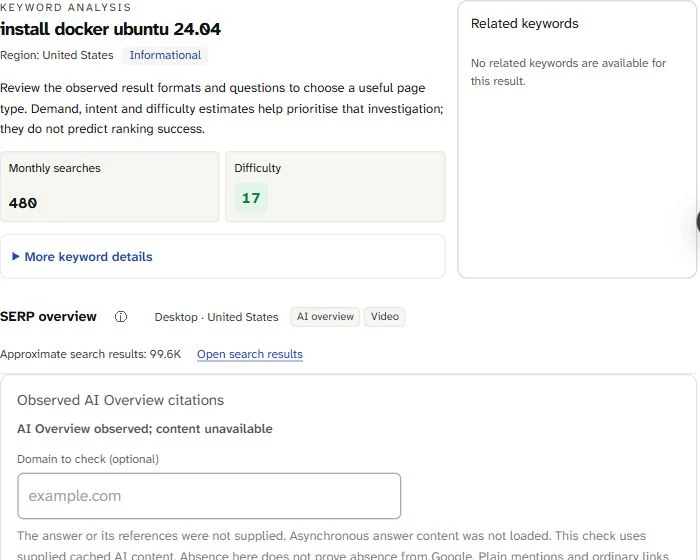
Beside SERP overview, two tags tell a tutorial writer something the table row does not: the results page has an AI overview and a Video block, so look at the videos before you decide how to present your steps. That row's 480 and 17 reappear here as Monthly searches and Difficulty, under the same Informational tag.
For this row the Related keywords box was empty: "No related keywords are available for this result." That is one more reason the comparison between releases comes from the version-free search, not from the release row.
What the results page holds
Three YouTube videos share one block on Google's results page for this search, set between the third and fourth of its eight ordinary results. SearchCub noted an AI overview heading the page but kept none of its content, so its answer is unknown here. The SERP overview shows all of this. Its header reads Desktop · United States, and SearchCub ran the check on 8 October 2026.
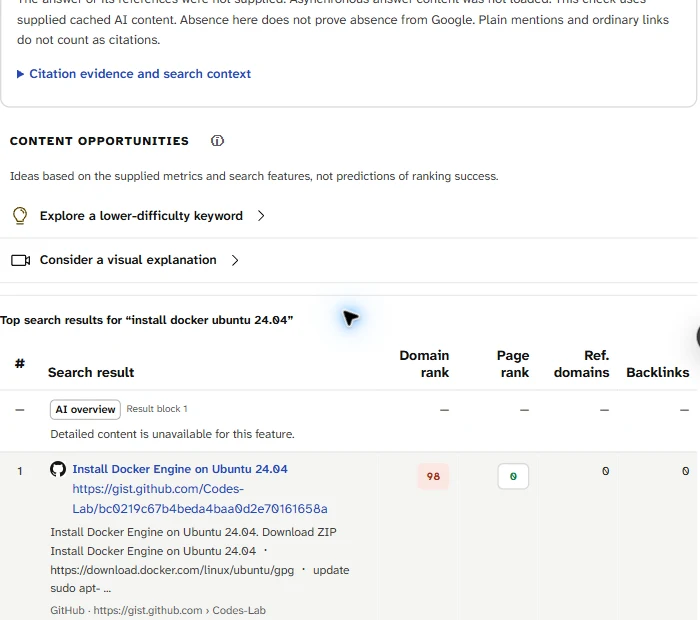
Under Content opportunities, SearchCub suggests Explore a lower-difficulty keyword and Consider a visual explanation. Below them, the AI overview's row says its detailed content is unavailable, which leaves the eight ordinary results to judge.
gist.github.com. What it is: A gist titled for Docker Engine on Ubuntu 24.04; its snippet shows Download ZIP and the start of a command. Date shown: None.
blog.botum.ca. What it is: "Install Docker on Ubuntu: The Complete 2026 Guide", written in the first person. Date shown: Mar 12, 2026.
linuxtoday.com. What it is: A how-to article for Ubuntu 24.04. Date shown: Apr 29, 2024.
solodev.app. What it is: A guide to installing and uninstalling Docker Desktop on 24.04. Date shown: Feb 17, 2025.
forums.docker.com. What it is: A thread about a network error with Docker Engine on 24.04. Date shown: Jan 18, 2025.
youtube.com. What it is: A step-by-step video for 24.04. Date shown: Sep 27, 2024.
forums.docker.com. What it is: A thread from someone who followed documentation and could not finish a Docker Desktop install on 24.04. Date shown: Sep 2, 2025.
linux.how2shout.com. What it is: A guide to installing Docker on 24.04 with Snap. Date shown: Jul 11, 2024.
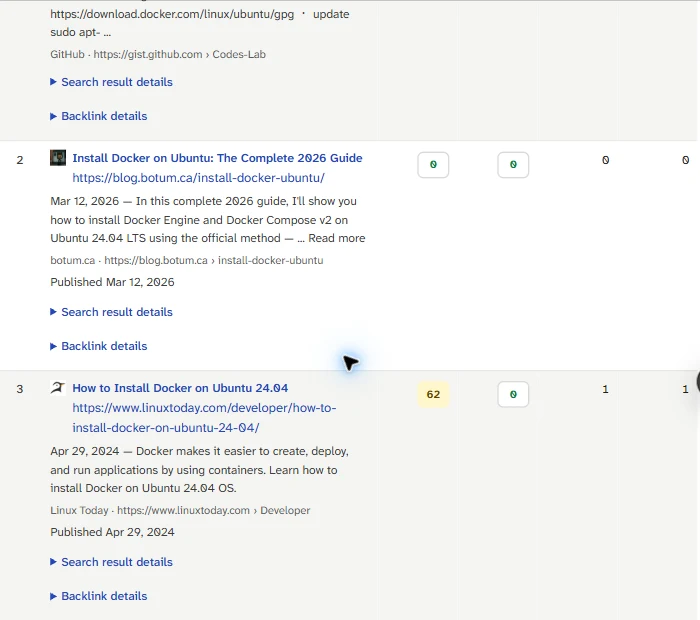
Places 2 and 3 carry their dates: a first-person guide published March 12, 2026, then a Linux Today article from April 29, 2024. Both are about Ubuntu 24.04, almost two years apart.
Taken together, the eight results say this about your plan:
Docker's own documentation is not among the eight. No docs.docker.com page appears; the only results on a Docker address are two community forum threads.
Every result is pinned to a release or a year. Seven of the eight titles name Ubuntu 24.04, and the eighth names 2026. Seven show a date, from April 2024 to March 2026.
They install different things. Results 1 and 5 are about Docker Engine, 4 and 7 about Docker Desktop, and 8 uses Snap; the snippet of result 2 promises Docker Engine plus Docker Compose v2. The search itself does not say which of these a reader wants, so your title and first lines should say which one your steps install.
Failure is part of the page. Two results are forum threads where an install went wrong; one snippet reads "unable to complete the installation process". Those readers need the error and its fix.
Video takes a block of its own. Besides that block, a fourth video ranks sixth, and the Consider a visual explanation prompt points the same way. A recording of the run you tested is the natural companion to the written steps.
Pages with zero recorded links sit near the top. The gist at 1 and the blog at 2 both read 0 under Ref. domains and Backlinks, and the blog's two rank columns read 0 as well. That is no forecast for your page, but the links SearchCub recorded show no heavily linked page among the eight.
What a tested, dated page adds
Most of these results cover one release, they were published across about two years, and two of them record installs that went wrong. What a reader still has to guess is whether the steps work on their machine today. A tutorial blog can settle that by showing its working:
The versions, up front. Name the Ubuntu release and the Docker product in the title, and the install method in the first lines.
The test date. Say when you last ran the steps, near the top of the page.
Your own output. Show what the terminal or screen showed you on that run, including any error you hit and what fixed it.
The source you checked. Check every command against the software's own documentation for that release, and link it.
Google's guidance makes the same case in general terms: it suggests letting readers see how your content was made, and it illustrates the point with product reviews, where trust can grow when readers learn how many products were tested, what the results were and the testing method, backed by evidence such as photographs (Google: creating helpful content). The release, the date and your output do that job in a tutorial.
The date needs the same honesty. Among the warning signs of content made mainly for search engines, the same page lists "changing the date of pages to make them seem fresh when the content has not substantially changed." When a new release changes the steps, retest and rewrite the page before you change its date.
The Docker-on-Ubuntu queue
For this keyword set, the evidence lines up like this:
Docker Engine on Ubuntu 24.04. Rows it covers (monthly searches, difficulty):
install docker ubuntu 24.04(480, 17) andubuntu 24.04 install docker(170, 15). Why it sits here: The largest release row, with a lower score than the 22.04 and 20.04 rows; 8 of the 14 release rows name 24.04 or 24, and its results page has a first-person blog and two forum threads in the top eight.Docker on Ubuntu Server. Rows it covers (monthly searches, difficulty):
install docker ubuntu server(720, 23),how to install docker on ubuntu server(170, 24),install docker ubuntu server 24.04(30, 14). Why it sits here: More searches than any release row, and the two server rows without a release held level or grew over the year. Open their own SERP overview first: this guide checked only the 24.04 results.Adding Docker Compose. Rows it covers (monthly searches, difficulty):
install docker and docker-compose ubuntu(880, 19). Why it sits here: Bigger than the 24.04 row and low in difficulty. Result 2 already pairs Engine with Compose, so decide between a page of its own and a section of tutorial 1.Docker Desktop on Ubuntu. Rows it covers (monthly searches, difficulty):
docker desktop ubuntu(390, 37),how to install docker desktop on ubuntu(90, 22). Why it sits here: Two of the eight 24.04 results are about Desktop, one of them a failed install. Skip it unless Desktop is part of your own setup.Removal and error fixes. Rows it covers (monthly searches, difficulty):
uninstall docker ubuntu(390, 10) and the three error rows (difficulty 0). Why it sits here: Short posts or sections, each built from something that happened on your own runs.Docker Engine on Ubuntu 22.04. Rows it covers (monthly searches, difficulty):
install docker ubuntu 22.04(140, 27),how to install docker on ubuntu 22.04(70, 15). Why it sits here: Fewer searches, a higher score and a steeper fall than 24.04. Leave it unless that release is still on a machine you use.
Debian, Windows and Linux Mint sit outside the queue: each starts with its own search. Every tutorial in it names the release it was tested on, so tutorials 2 to 5 can point back to tutorial 1 when they share that release.
Do the same for your own software
Whatever software you teach, Keyword ideas shows what readers add to a task once you leave the version out, grouping keywords and mapping them to pages settles which setups share a page, and the last step of keyword research for bloggers gives the first tutorial a short brief.
Then run the steps on the release that tutorial covers, and keep notes as you go: the release and product versions, the date, every command with what it printed, and each error with the fix that worked. Write the tutorial from those notes rather than from memory. When a new version of the software comes out, the notes become your retest: run the same commands on the same release, rewrite any step that changed, and only then change the test date.