- Competitor Research
- Checklist
How to choose SEO competitors for a small site
Editorial responsibility: SearchCub
Choose SEO competitors that answer the same reader questions in your target market, even when their businesses look different from yours.
For a small site, the most useful competitor is often a particular page or topic section. A huge domain's overall traffic can distract you from the pages your readers actually compare.
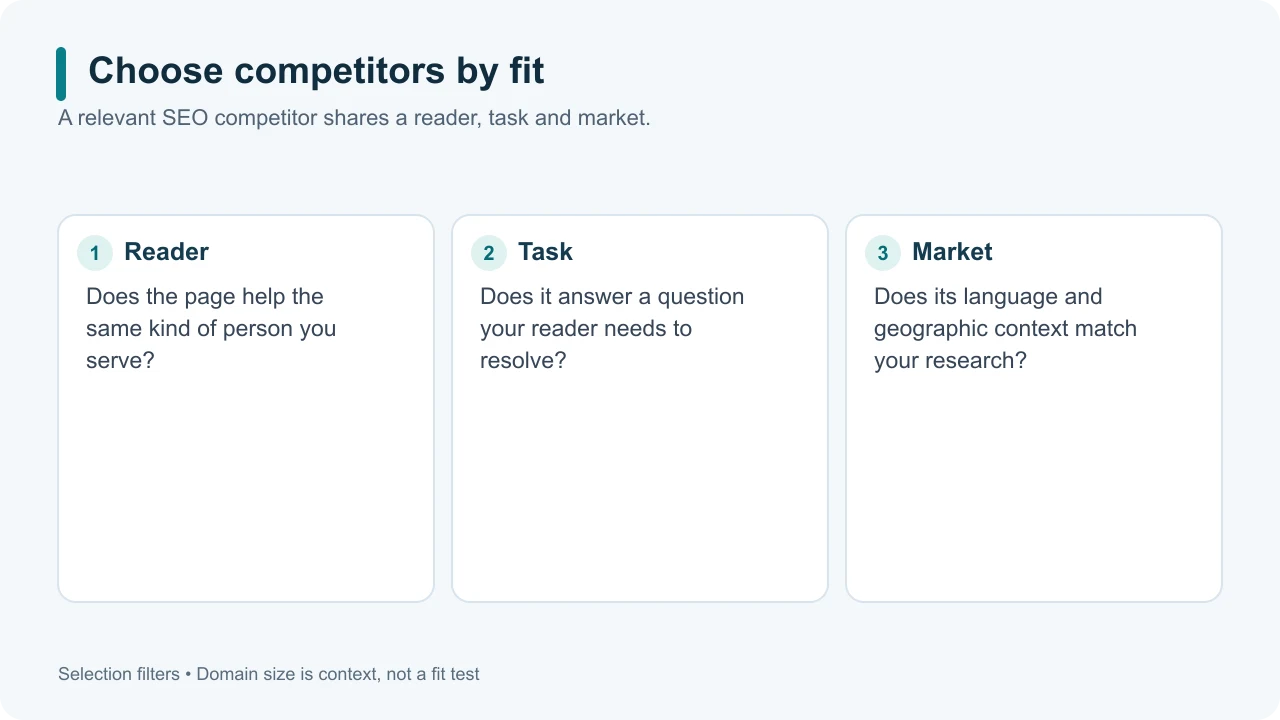
Original illustrative diagram: competitor selection begins with fit, before domain size.
Start with three real reader questions
List a few tasks you want your site to help people complete. For a hypothetical apartment-gardening blog, these could be choosing herbs for a shaded balcony, watering an indoor basil plant, and identifying why leaves turn yellow.
Search the questions using your intended language and market. Record the organic pages you see, their domains and the date. Inspect pages directly. A result titled “basil care” might be a store listing, an encyclopedic entry or a practical troubleshooting guide.
Keep the research conditions beside your notes. Google describes location, settings and query meaning among the factors used to return results. Treat your observation as a snapshot rather than a universal ranking. How Search ranks results.
Our search intent guide can help you describe the task before comparing domains.
Separate three kinds of competitor
Kind | Why you might study it |
|---|---|
Business competitor | Offers a competing product or service to your customers |
Search competitor | Appears for the reader questions you want to answer |
Reference publisher | Produces strong examples you can learn from, even when it is not a close search rival |
One site can occupy several roles. Keep the roles explicit so you do not accidentally treat every respected publisher as a realistic benchmark for your next article.
Use a fit checklist
Ask these questions before adding a domain to your working list:
Does it serve a reader comparable to ours?
Do its relevant pages solve the same task?
Is the language, country or local context appropriate?
Does it appear across several related questions, or only one?
Can we create a useful answer within our own expertise and resources?
Are we studying the relevant section rather than unrelated domain totals?
Choose a few good matches and write a sentence explaining each choice. A sensible small-site research set might include two comparable publishers and one larger reference publisher. This is a manageable working size, not a ranking rule.
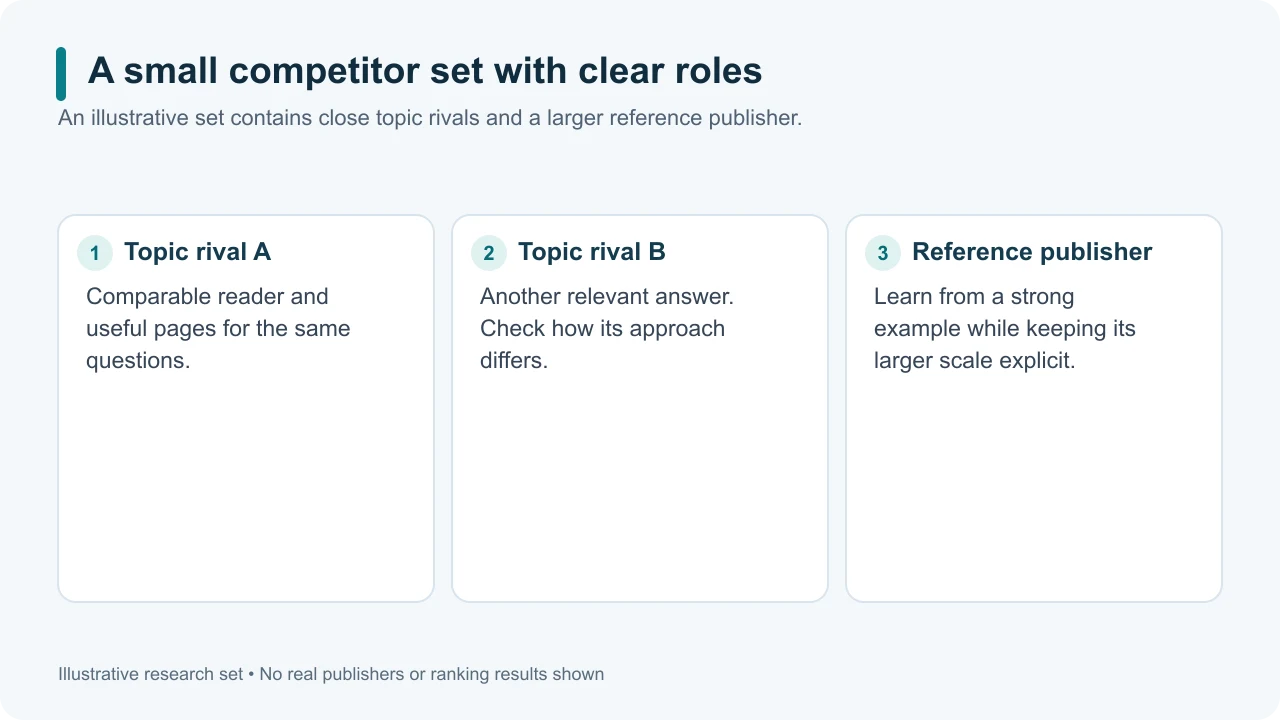
Original illustrative diagram: keep the benchmark's role clear when its scale differs from yours.
Reject misleading matches
In our hypothetical example, a national retailer selling basil plants could compete for a buying query. It may be less useful for a detailed watering guide. A general news site with one successful herb article belongs in that page's comparison, not automatically in a long-term competitor roster.
A competitor can also reveal an opportunity you should decline. If its article depends on specialist testing or geographic knowledge you do not have, do not imitate the claim. Choose a problem you can substantiate.
Finish with a compact record: domain, relevant URLs, reader overlap, topic overlap, market, reason selected and questions to revisit. Keep uncertain matches as candidates rather than assigning them invented relevance scores.
Once you have selected a relevant rival, continue with competitor keyword research to turn that choice into a shortlist.
Take one matched page into your next research session. Open SearchCub when you are ready to investigate its topic, and keep your competitor notes focused on the reader question that made the page relevant.